

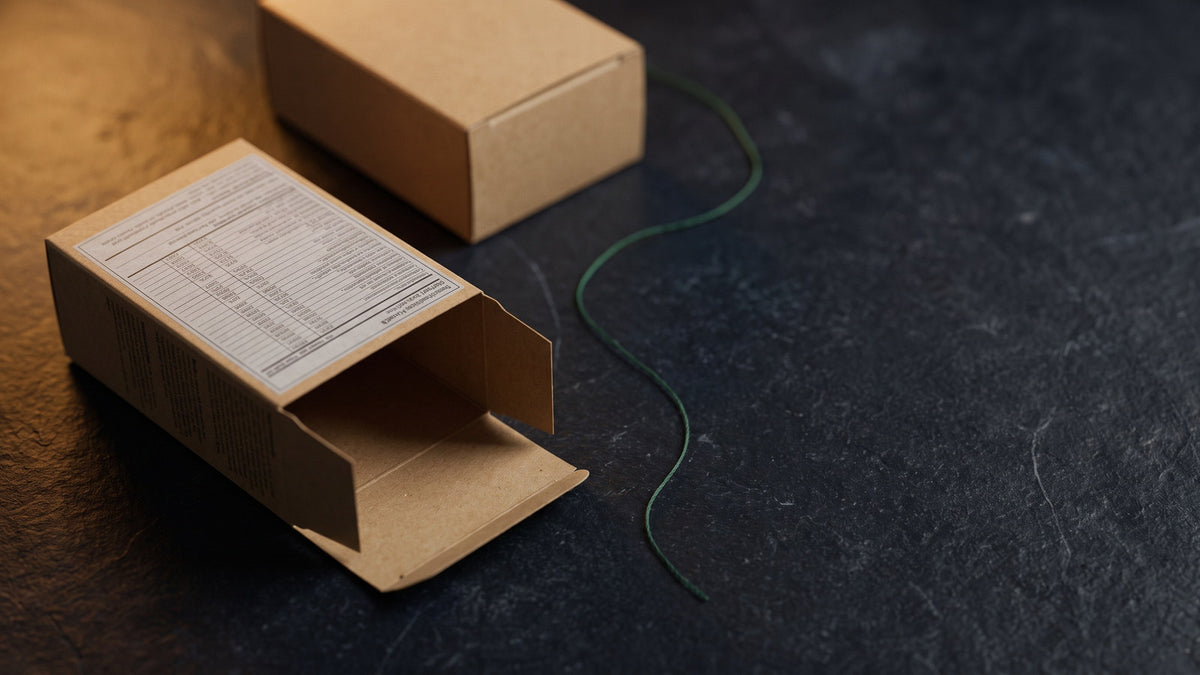
A proprietary blend is a group of ingredients declared as one combined weight — 500 mg, 1,000 mg, whatever it is — with the plants listed underneath in order but without individual amounts. The total says nothing about the split. It could be 900 mg of one cheap bulk powder and 20 mg of each of the five names you were interested in, and the label would look the same either way.
UK food supplement rules ask for the amount of each substance with a nutritional or physiological effect, declared for the recommended daily portion. A grouped total is not that. There is no proprietary-blend category in the rules — the format was imported from the United States, where supplement labelling makes specific allowance for it.
A proprietary blend is a group of ingredients declared on a label as one combined weight. You get a name someone invented - a blend, a matrix, a complex - then a total, usually 500 mg or 1,000 mg or something larger, and underneath it a column of plant names with no figures against them. The total is real. The split between the plants is not disclosed.
It is a formatting decision rather than a formulation one, and it changes what the pack is. A label with amounts can be compared with another label. A label with a blend total can only be taken on trust.
What is a proprietary blend on a supplement label?
The layout is always the same, which is what makes it easy to recognise once you have seen it. A heading with a proprietary-sounding name. A weight beside it. Then the plants listed underneath, in order, in a column, with nothing in the right-hand margin where the milligrams should be.
What a blend total does not tell you
Work through the arithmetic and the size of the gap becomes obvious. A 1,000 mg blend of six plants could be roughly 167 mg of each. It could equally be 900 mg of whichever plant is cheapest by the kilo and 20 mg of each of the other five. Both packs print the same total. Both print the same six names. If the cheap one happens to be the heaviest, both print them in the same order. Nothing on either label separates the two formulations. The buyer has not been given a small amount of information. They have been given a number that is compatible with almost any recipe.
Bulk is cheap and concentration is not. A dried root or leaf powder can be bought by the sack; a standardised extract of the same plant costs several times more per kilo. A blend total lets the first pay for the headline number while the second, present in a much smaller quantity, pays for the name on the front of the box. Nothing about that arrangement has to be declared, because the only figure on the label is the sum.
A blend also conceals two things that are easy to overlook. The first is extract strength. Two hundred milligrams of dried ginseng root and two hundred milligrams of a concentrated ginseng extract are different materials, and a combined total does not distinguish between them at all. The second is species. A full list prints the botanical name - Panax ginseng, Lepidium meyenii - because common names are shared between unrelated plants. Blends tend to print the common name only, which is the vaguer of the two options and the cheaper one to stand behind.
What does UK law require a supplement label to declare?
Food supplements sold in Great Britain are labelled under the Food Supplements Regulations - a separate set for England, Scotland, Wales and Northern Ireland, all saying the same thing - which sit on top of general food-labelling law. The requirement that matters here is short. The amount of the substances that have a nutritional or physiological effect must be declared on the label, expressed for the recommended daily portion.
Read that with a blend in mind. The duty attaches to the substances. It does not attach to the group that a manufacturer has decided to bracket them into. Six botanicals in a tablet are six substances, and printing a name and a total around them does not turn them into one.
Where the proprietary blend format came from
The convention itself is an import. United States supplement labelling makes specific allowance for a blend declared as a single total, which is why the format is so familiar from American packs and from the gym-supplement aisle that copies them. Great Britain has no equivalent allowance. The blend arrived here as a house style, not as a legal category.
So the honest answer to whether proprietary blends are legal in the UK is that there is no such thing as a proprietary blend in the rules. There is a duty to declare amounts, and a label either does it or does not. Whether any particular pack on any particular shelf meets that duty is a question for the local authority that enforces food labelling, and not something one brand should pronounce on about another. What can be said without any difficulty at all is that a blend total gives you less than the rules were written to give you.
Why do supplements hide the amount of each ingredient?
Does the trade secret argument hold up?
The trade secret argument is the one you will hear first. Publish the amounts, the reasoning goes, and a competitor copies the formula overnight. It does not survive much pressure. A competitor who genuinely wants a formula buys a pack and sends it to an analytical laboratory, and the answer comes back in a fortnight. Reverse-engineering a botanical tablet is routine work, and it is not expensive relative to launching a product. The blend is a poor defence against a rival with a budget. It is a very effective defence against a customer with a phone.
The second reason is cost, and it is the real one. If the amounts are printed, an underdosed ingredient is visible in a single glance: the plant that sold the product sits at the bottom of the column with a small figure next to it. Inside a blend that is invisible. The practice has a name in the trade - label dressing - and it means including a fashionable plant in a quantity small enough that it functions as a word on the front of the pack rather than as a component of the tablet.
The third reason is that a big number is easier to design around than six small ones. A 1,200 mg complex looks generous on a shelf. It says nothing about what is in it, and there is no obligation to explain that most of the weight is one bulk powder, but it photographs well and it fits neatly under a headline. Six separate figures are harder to lay out and harder to romanticise, which is most of why fewer packs carry them.
None of this means a large total is dishonest or a small one is virtuous. A total is simply the wrong figure to compare, in either direction. The number worth looking at is the amount of each named plant per recommended daily portion, and that is the figure a blend removes.
How do you spot a proprietary blend on a pack?
Turn the pack over and work down the panel the way you would read any supplement label. You are looking for four signs, and one of them is usually enough:
- a group of ingredients under an invented heading - blend, matrix, complex, formula, system;
- one weight printed against that heading rather than against the ingredients;
- plant names in a column with an empty right-hand margin;
- a footnote explaining that amounts are not disclosed, or no footnote at all.
There is a second check that works even when the panel has been designed to be difficult. Ingredients have to be listed in descending order of weight, and that rule applies inside a blend as well as outside it. So the order is a dose clue even when the numbers are missing. If the plant you bought the pack for is fifth of six inside a 1,000 mg blend, you now know it is one of the two smallest components of that total, whatever the front of the box says about it.
The same rule works one level up, and this is the check most people miss. The blend is only one entry in the product ingredient list. If a bulking agent or a filler appears above the blend in that list, the filler outweighs everything in the blend put together. That comparison is available on almost every pack, costs nothing, and is not affected by how the blend itself is written.
If the panel still leaves you guessing, the last check is to ask. Any brand has the figures, because a factory cannot press a tablet without a specification that lists every input by weight. A brand that can send you the per-plant amounts on request has simply chosen not to print them. A brand that answers with a paragraph about proprietary formulation has told you something as well.
What full disclosure looks like
Full disclosure, by contrast, is unremarkable to look at. It is a plain table:
- every botanical named individually, with its Latin binomial;
- a milligram figure against each one, per recommended daily portion;
- the form stated - dried powder or extract, and the ratio if it is an extract;
- a dagger against the botanicals resolving to a note that no Nutrient Reference Value has been established, because NRVs exist for vitamins and minerals and not for plants;
- a total that is simply the sum of the figures above it, if a total is printed at all.
Our own panel reads Ginseng (Panax ginseng) 25 mg, Maca (Lepidium meyenii) 25 mg, Tribulus terrestris 20 mg, Guarana (Paullinia cupana) 10 mg, Ashwagandha (Withania somnifera) 10 mg, Catuaba (Trichilia catigua) 10 mg. Six figures adding to 100 mg per tablet, with a maximum of one tablet in any 24-hour period, and the caffeine that comes with guarana declared at under 5 mg a tablet. The tablets are pressed in the UK on a GMP-registered line and tested at a laboratory accredited to ISO/IEC 17025, and the batch code printed on the blister foil next to the best-before date is what ties a specific pack to a specific set of results. Quote it to hello@maleup.co.uk and the certificate for that run comes back.
What the panel does not do is tell you what the plants will do, because it is not allowed to and neither are we. None of the six holds an authorised health claim in Great Britain. A label here may name a plant and describe its traditional use†, marked as tradition rather than as evidence, and it may print an amount. That is the whole permitted vocabulary.
The total is a marketing number. The split is the formulation. When a brand prints the split it has accepted that anyone can check its arithmetic against anyone else's, which is a modest thing to do and is still unusual enough to be worth noticing. When a brand prints one number instead, that is not a secret being kept from a competitor. It is a comparison being kept from you.
- A blend prints one total and hides the split between the plants.
- That total is compatible with almost any recipe: bulk powder is cheap, extract is not.
- UK rules ask for the amount per substance, per recommended daily portion.
- Order still applies inside a blend — last in the column is the smallest part.
- If a filler is listed above the blend, the filler outweighs the whole blend.
Common questions
Are proprietary blends legal in the UK?
There is no category called a proprietary blend in the UK rules. The requirement is that the amount of each substance with a nutritional or physiological effect is declared for the recommended daily portion, and a single grouped total gives less than that. Whether a particular pack meets the requirement is a matter for the local authority that enforces food labelling.
What is the difference between a proprietary blend and full disclosure?
A proprietary blend prints one combined weight, with the plants listed underneath and no figures against them. Full disclosure prints a milligram amount against every named botanical, with its Latin name, for the recommended daily portion. The first tells you the sum. The second tells you the formulation, and lets you compare one pack against another.
How can I tell how much of an ingredient is in a proprietary blend?
From the label, you cannot, and that is what the format is for. The only clue is order: ingredients are listed heaviest first, inside a blend as well as outside it, so a plant near the bottom of the column is one of the smallest parts of the total. For an actual figure you have to ask the brand.
Is a 1,000 mg proprietary blend better than a smaller blend with the amounts printed?
Neither number answers that on its own. A large total says nothing about the split between the plants, and nothing about whether each one is a dried powder or a concentrated extract. A smaller total with an amount printed against each named botanical is the only version of the panel you can compare with anything else.
Why do supplement brands say their formula is a trade secret?
Because it sounds better than the alternative. A competitor who wants a formula buys a pack and sends it to an analytical laboratory, which is routine work and not expensive, so a blend is a weak defence against a rival with a budget. It works much better against a customer comparing two boxes in a shop.
Do the ingredients inside a proprietary blend have to be listed in order?
Yes. Ingredients are listed in descending order of weight, and that applies inside a blend as well as to the main list. Position is therefore a rough dose clue even with the figures missing. The same rule one level up means that if a bulking agent sits above the blend, the filler outweighs all of it.
- Food Supplements (England) Regulations 2003, regulation 6 — legislation.gov.uk Amounts of substances with a nutritional or physiological effect must be declared per recommended daily portion.
- Regulation (EU) 1169/2011 on food information to consumers — legislation.gov.uk Ingredients listed in descending order of weight.
- Food supplements guidance — GOV.UK
Six botanicals, 100 mg per tablet, every weight printed on the carton: Ginseng 25 mg, Maca 25 mg, Tribulus 20 mg, Guarana 10 mg, Ashwagandha 10 mg, Catuaba 10 mg. Maximum one tablet in any 24-hour period. Pressed in the UK on a GMP-registered line.
See the packs →† Describes the traditional use of these botanicals (UK 'on-hold' botanical claims under retained Regulation (EC) 1924/2006). Not authorised EFSA health claims. AllMaleUp is a food supplement, not a medicine.