

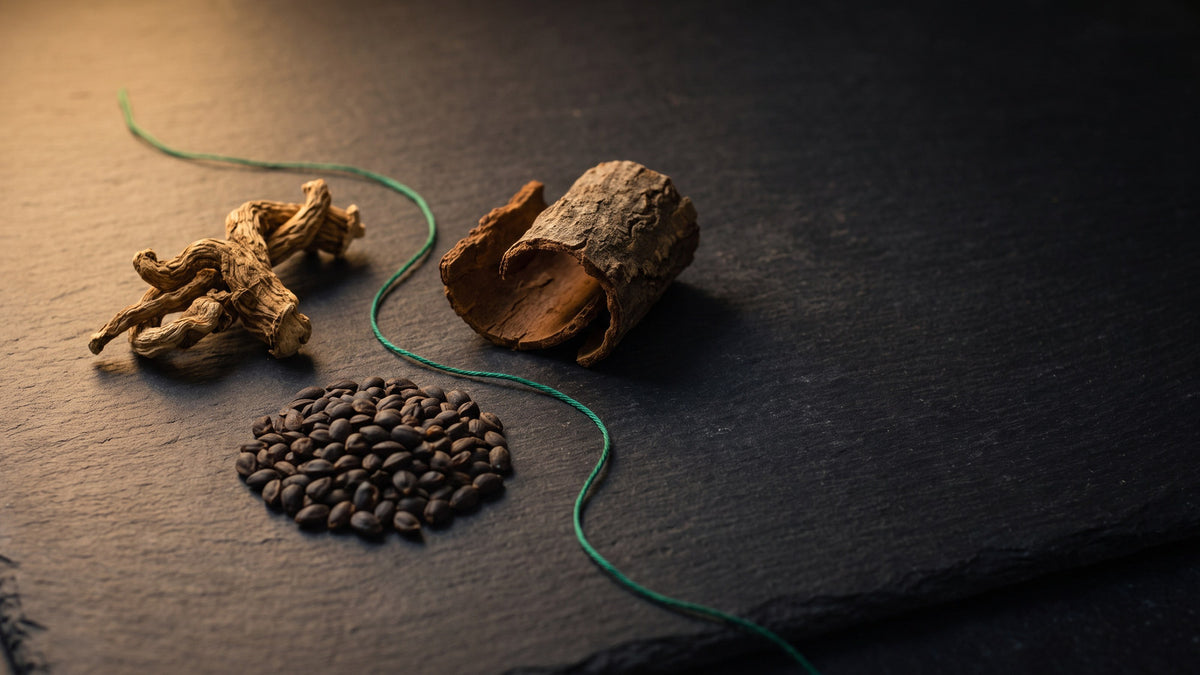
Six plants from four continents: maca from the Junín plateau in Peru, tribulus from Bulgaria, guarana and catuaba from Brazil, ginseng from South Korea and ashwagandha from Rajasthan in India.
Origin is worth printing because it is one of the few claims on a supplement label that can be verified. It says nothing about effect — a root grown at 4,000 metres is not a better root for it.
Six plants, four continents, one tablet. The blend is small - 100 mg in total - but the supply chain behind it is not, and the places involved are specific rather than decorative.
This is where each of the six actually comes from, and why the origin is printed on the pack at all.
Where do maca and tribulus come from?
Lepidium meyenii grows on the Junín plateau in central Peru, at roughly 4,000 metres. It is a punishing place to farm - thin air, hard frosts, strong sun - and maca is one of the few food crops that will tolerate it. Andean communities have grown and eaten the root there for generations, usually dried in the open air for weeks before it is cooked or milled.†
That drying step is not a modern processing choice. It is the traditional method, and it is the reason maca travels as a hard, storable root rather than a fresh vegetable. Ours is cultivated, not wild-gathered, which matters on a plateau where wild stands would not survive commercial demand.
Tribulus terrestris: Bulgaria and two herbal traditions
Two thousand miles away and 4,000 metres lower, Tribulus terrestris is a low, sprawling vine that grows across southern Europe, and Bulgaria has become the reference source for it in the herbal trade. It is a roadside plant in the literal sense - it will colonise dry, poor, disturbed ground that nothing else wants, which is exactly the kind of land it is harvested from.
It appears in two separate herbal traditions that never borrowed from each other: Balkan folk practice on one side, Ayurveda on the other, where it is known as gokshura.† The aerial parts and fruit are the parts used. Harvest is in late summer, once the fruit has set.
Where do guarana and catuaba come from?
Paullinia cupana is a climbing vine from the Maués region of Brazil. The Sateré-Mawé people have cultivated and prepared it for centuries - the seed is roasted, ground and grated into water, and the practice is old enough to be woven into their origin stories.† The seed naturally contains caffeine, which is why guarana ended up in soft drinks and why our tablet carries under 5 mg of it. Ours is wild-harvested.
Catuaba: bark from the Brazilian Atlantic forest
Trichilia catigua is the quietest name on our label. It is the bark of a small tree from the Brazilian Atlantic forest, used in Brazilian herbal tradition and barely known outside it.† Bark is a slower crop than seed or root: it is taken from mature trees, it cannot be rushed, and the supply is correspondingly narrow.
Where do ginseng and ashwagandha come from?
Panax ginseng is the most documented root in this blend and the most demanding to grow. A commercial crop is lifted after four to six years in the ground, by which point the field is exhausted and is generally not replanted with ginseng for a decade or more. Ours is cultivated in South Korea, where the crop is a national industry with its own grading conventions.†
Ashwagandha: Rajasthan and the end of the growing season
Withania somnifera is a shrub of dry, hot ground, and India's Rajasthan is the main growing region. The root is the part used in Ayurvedic practice, harvested at the end of the growing season when the plant dies back.† It is milled and pressed into our tablets in the UK.
Why is the country of origin printed on the pack?
Origin is not a flourish. It is the first thing that changes when a supply chain is under pressure, and it is one of the few claims on a supplement label that can be checked.
Species substitution, and the test that catches it
Botanical raw material is traded through a chain of collectors, driers, brokers and extractors, and by the time it reaches a manufacturer it can have passed through half a dozen hands. Species substitution is a real problem in that trade - a cheaper relative dried and milled looks much like the plant you ordered. The defence against it is identity testing on arrival: each batch of raw material is confirmed as the species it is supposed to be before it goes anywhere near a tablet press.
So the origin line on the pack is really a shorthand for a longer answer. It says we know which country each plant came from, that we know whether it was cultivated or wild-harvested, and that the batch in front of you was tested before release. Ask for the Certificate of Analysis with your batch code at hello@maleup.co.uk and you will see the identity results for that specific run.
What origin does not do is tell you anything about effect. A root grown at 4,000 metres is not a better root because of the altitude; it is a root that grows where it grows. The geography is interesting, and it is verifiable, and that is the whole of the claim we are making about it.
Six plants, six declared weights, six places on a map. Everything else about them we have left to tradition and to the label.
- Maca (Lepidium meyenii) 25 mg — Junín plateau, Peru, cultivated at ~4,000 m.
- Tribulus terrestris 20 mg — Bulgaria, aerial parts and fruit, harvested late summer.
- Guarana (Paullinia cupana) 10 mg — Maués, Brazil, wild-harvested seed.
- Catuaba (Trichilia catigua) 10 mg — bark, Brazilian Atlantic forest.
- Ginseng (Panax ginseng) 25 mg — South Korea, lifted after four to six years.
- Ashwagandha (Withania somnifera) 10 mg — Rajasthan, India, root.
Common questions
Where does the maca in AllMaleUp come from?
The Junín plateau in central Peru, at roughly 4,000 metres, where Andean communities have grown and eaten the root for generations. Ours is cultivated rather than wild-gathered.
Why is Bulgarian tribulus the reference source?
Tribulus terrestris grows across southern Europe, and Bulgaria has become the reference source for it in the herbal trade. It colonises dry, poor, disturbed ground, which is the kind of land it is harvested from.
Does guarana contain caffeine?
Yes. Guarana seed naturally contains caffeine — it is why the plant ended up in soft drinks. Each AllMaleUp tablet carries under 5 mg of it, which is less than a cup of decaf.
How long does Korean ginseng take to grow?
A commercial Panax ginseng crop is lifted after four to six years in the ground. The field is then exhausted and generally not replanted with ginseng for a decade or more.
Does where a botanical is grown affect how well it works?
No claim of that kind is made here. Origin is verifiable and it is the first thing that changes when a supply chain is under pressure, which is why it is printed. It is not evidence of effect.
What is species substitution in the botanical trade?
Raw material passes through collectors, driers, brokers and extractors, and a cheaper relative dried and milled can look much like the plant that was ordered. The defence is identity testing on arrival, before anything reaches a tablet press.
Six botanicals, 100 mg per tablet, every weight printed on the carton: Ginseng 25 mg, Maca 25 mg, Tribulus 20 mg, Guarana 10 mg, Ashwagandha 10 mg, Catuaba 10 mg. Maximum one tablet in any 24-hour period. Pressed in the UK on a GMP-registered line.
See the packs →† Describes the traditional use of these botanicals (UK 'on-hold' botanical claims under retained Regulation (EC) 1924/2006). Not authorised EFSA health claims. AllMaleUp is a food supplement, not a medicine.