

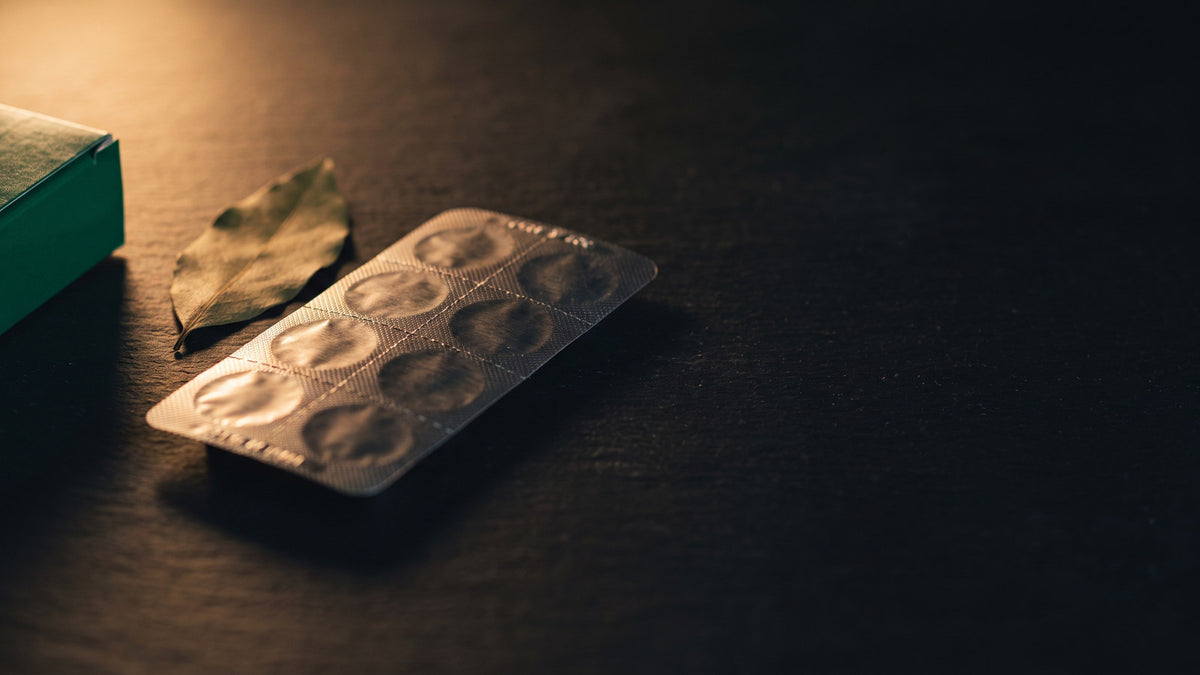
A blister protects better because each cavity is sealed on its own until you push the tablet through the foil. A tub is opened and closed dozens of times, and every opening exchanges the air inside for room air — which is why tubs need a desiccant sachet and an induction seal to mitigate a problem the blister never has.
Store either below 25°C, dry and out of direct sunlight. A bathroom shelf and a car glovebox both fail that test; a bedroom drawer or a kitchen cupboard away from the hob is fine.
Every AllMaleUp tablet sits in its own sealed blister cavity, backed with foil, inside a printed carton. That is a more expensive way to package a supplement than a plastic tub, and the reason has almost nothing to do with how it looks.
It has to do with air, water and time - and with the fact that a pack rarely stays where it was bought.
Blister pack or plastic tub: which protects the tablet?
A tub is opened and closed sixty times over its life. Every opening exchanges the air inside for room air, and room air carries moisture. The tablets at the bottom of a tub have therefore been exposed to two months of your kitchen before you ever get to them.
What the desiccant sachet and induction seal are really for
That is why tubs ship with a desiccant sachet and a foil induction seal: both exist to manage the humidity that the format itself lets in. They work reasonably well. They are still a mitigation.
A blister does not have the problem to mitigate. Each cavity is sealed on its own and stays sealed until the moment you push that tablet through the foil. Tablet forty is in the same condition as tablet one, because it has never met the outside air. Nothing else in the pack has been disturbed by taking it.
The secondary benefit is that you always know where you are. Twenty cavities, twenty tablets, and a glance tells you how many are left without counting anything.
What do moisture, heat and light do to a supplement?
A pressed botanical tablet is dry material held together under pressure. Water is the thing it is least happy with: absorbed moisture softens the tablet, and it is what allows anything microbiological to get going in a product that is otherwise too dry to support it. Moisture content is one of the figures checked on every batch before release for exactly that reason.
Heat, daylight and the 25°C storage line
Heat and daylight are slower problems. Plant material is a mixture of compounds, some of which are sensitive to ultraviolet light and to sustained warmth, which is why our storage instruction is a cool, dry place below 25°C and out of direct sunlight.
Two places fail that test in almost every house. A bathroom shelf is warm and repeatedly humid. A car glovebox in summer goes well past 25°C and stays there for hours. A bedroom drawer or a kitchen cupboard away from the hob is unremarkable and completely fine.
What is the difference between best before and use by?
Worth separating, because the two get used interchangeably and mean different things.
Use by is a safety date. It belongs on fresh, perishable food, and eating something after it is a genuine risk.
Best before is a quality date. It is the point up to which the manufacturer can stand behind the product being what the label says it is - the declared weights, the physical condition of the tablet. Food supplements carry a best-before date, and ours is printed on the blister foil next to the batch code.
The date assumes the storage conditions on the pack. A carton kept in a cupboard will make its date comfortably. The same carton left on a car dashboard for a fortnight has had a different life, and the date on it is no longer describing the same product.
How should you travel with a supplement pack?
The blister is the part that travels well: a strip flexes, does not rattle, does not spill if it is crushed in a bag, and cannot open itself.
Why the carton matters more than the strip
Our advice is to take the carton too, or at least the panel from it. The carton carries the ingredient list with all six weights, the batch code, the best-before date and the warnings, and a loose blister strip carries none of that. If anyone ever needs to know what you are carrying - airport security, a pharmacist abroad, a doctor - the answer is on the carton and nowhere else.
Which pack size travels
The 20-tablet pack exists partly for this. It is the smallest size we make, it fits a wash bag, and at a maximum of one tablet in any 24-hour period it covers a long trip without you taking a 60-pack across a border.
Two other things worth knowing. Guarana seed naturally contains caffeine, so each tablet carries under 5 mg of it - relevant if you are pairing it with a day that already includes coffee. And the pack has no special rules attached to it: it is a food supplement, not a medicine, and none of the six plants in it holds an authorised health claim in Great Britain.†
Good packaging is invisible when it works. It keeps the tablet in the condition it left the press in, it carries the information that proves what the tablet is, and it survives being thrown into a bag. That is the entire brief, and a blister in a carton meets it more cheaply than a tub that has to be babysat.
- Each blister cavity is sealed individually — tablet forty is in the same condition as tablet one.
- A tub's desiccant sachet and foil seal exist to manage a problem the format itself creates.
- Moisture is the main enemy of a pressed botanical tablet; heat and UV are slower ones.
- ‘Best before’ is a quality date. ‘Use by’ is a safety date, and belongs on perishable food.
- Travel with the carton, not just a loose strip — the carton carries the weights, batch code and warnings.
Common questions
Are blister packs better than bottles for supplements?
For moisture protection, yes. Each blister cavity is sealed on its own and stays sealed until the tablet is pushed through the foil, so the last tablet has never met room air. A tub exchanges its air for room air every time it is opened, which is why tubs ship with a desiccant sachet and an induction seal.
How should supplements be stored at home?
Cool, dry, below 25°C and out of direct sunlight. A bathroom shelf is warm and repeatedly humid and a car glovebox goes well past 25°C in summer; a bedroom drawer or a kitchen cupboard away from the hob is fine.
Is it safe to take a supplement after its best-before date?
Best before is a quality date, not a safety date — it is the point up to which the manufacturer can stand behind the product being what the label says. Use by is the safety date, and it belongs on fresh perishable food, not on food supplements. The date also assumes the storage conditions printed on the pack were followed.
Can you take supplements in hand luggage?
Food supplements carry no special rules — they are food, not medicine. Take the carton or at least the printed panel with you, because a loose blister strip carries none of the ingredient weights, batch code, best-before date or warnings that answer a question at a border or a pharmacy counter.
Why is there a desiccant sachet in supplement tubs?
To absorb the moisture that the tub format lets in every time it is opened. It works reasonably well, but it is a mitigation for a problem that individually sealed blister cavities do not create.
Which pack size is best for travelling?
The 20-tablet pack. It is the smallest size made, it fits a wash bag, and at a maximum of one tablet in any 24-hour period it covers a long trip without taking a 60-pack across a border.
Six botanicals, 100 mg per tablet, every weight printed on the carton: Ginseng 25 mg, Maca 25 mg, Tribulus 20 mg, Guarana 10 mg, Ashwagandha 10 mg, Catuaba 10 mg. Maximum one tablet in any 24-hour period. Pressed in the UK on a GMP-registered line.
See the packs →† Describes the traditional use of these botanicals (UK 'on-hold' botanical claims under retained Regulation (EC) 1924/2006). Not authorised EFSA health claims. AllMaleUp is a food supplement, not a medicine.