

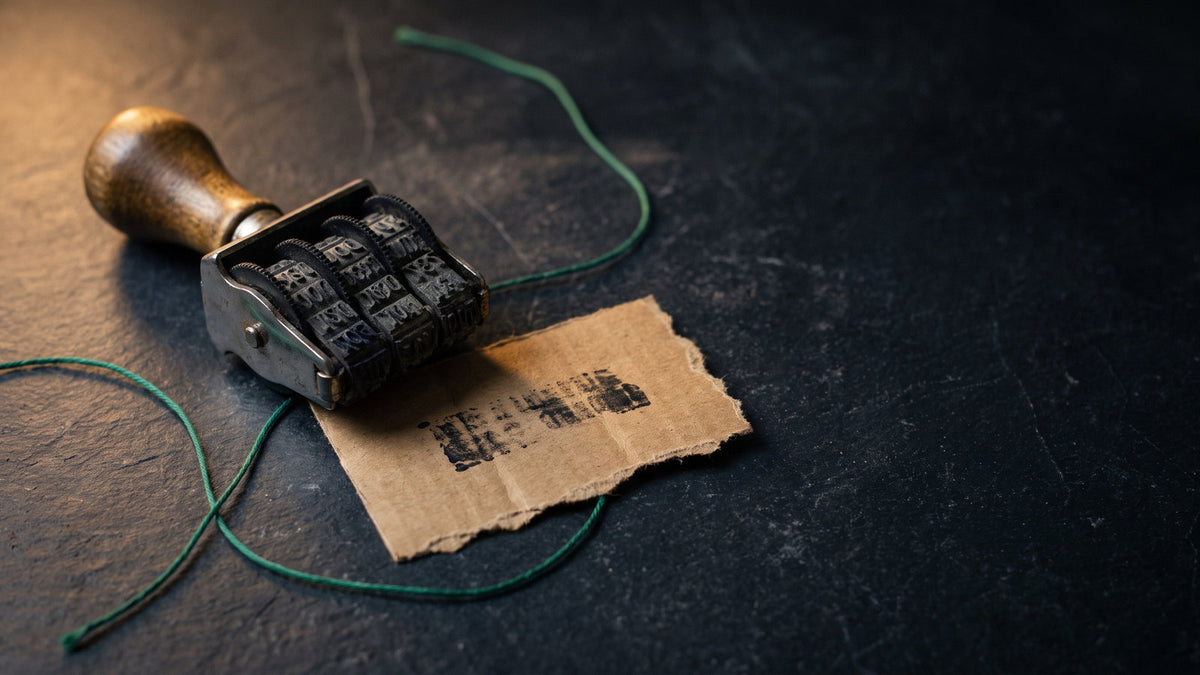
A batch number identifies one continuous production run made from one set of raw materials. Every test result and every raw-material lot for that run is filed against the code, which is what makes the rest of the pack checkable.
Email the code from the side of your carton to hello@maleup.co.uk and you get the Certificate of Analysis for those tablets — identity, heavy metals, microbiology and the physical specification.
There is a short code stamped on the side of every AllMaleUp carton, next to the best-before date. It is not a design element and it is not a serial number for your pack. It identifies the production run your tablets came from.
It is the least glamorous thing we print, and it is the one that makes everything else on the pack checkable.
What is a batch number on a supplement?
A batch is one continuous production run made from one set of raw materials. The same delivery of ginseng, the same delivery of maca, the same tablet press, the same day, the same operators, the same paperwork.
When that run ends and the next one begins - new raw material deliveries, a new run - it gets a new code. Two packs with the same batch code came from the same tonne of powder. Two packs with different codes did not, even if they look identical and sit next to each other on the same shelf.
That is the whole idea. A batch code turns 'a pack of tablets' into 'this specific set of tablets, made on this day, from these materials', and everything a manufacturer knows about that day is filed against the code.
What does a batch number let a manufacturer do?
Three things, mainly.
Tracing backwards to the raw material
It traces backwards. From the code on your carton we can reach the raw material lots that went into the blend, and from those lots back to the supplier and the country of origin. This is a legal requirement for food in Great Britain, not a courtesy - businesses have to be able to identify who supplied them and who they supplied, one step back and one step forward.
Tracing forwards to the packs on shelves
It traces forwards. If a problem is ever found in a raw material after the fact, the code tells us exactly which finished packs contain it and where they went. Without batch coding the only honest response to a raw material problem would be to withdraw everything. With it, the response is precise and small.
Anchoring the test results
It anchors the testing. Every batch is tested before release, and the results are filed against that code. Retention samples from the run are kept as well, so the same batch can be re-tested later if a question comes up. A test result with no batch code attached is a piece of marketing. A test result with a batch code is a record.
How do you get the Certificate of Analysis for your pack?
Email the code from the side of your carton to hello@maleup.co.uk and we send you the Certificate of Analysis for that batch. Not a generic sample certificate, not last year's - the one for the tablets in your hand.
What a Certificate of Analysis covers
A CoA for a botanical supplement typically covers four things:
- Identity. Confirmation that each botanical is the species declared on the label, which is the check that catches substitution in the raw material trade.
- Heavy metals. Lead, cadmium, mercury and arsenic, tested against the limits set for food. Plants take up what is in the soil they grew in, so this is a routine test for anything root-based.
- Microbiology. Total viable counts and checks for organisms including E. coli and Salmonella.
- The physical spec. Tablet weight, moisture, and confirmation that the declared amounts are what went in.
Why the testing laboratory’s accreditation matters
Our batches are pressed in the UK on a GMP-registered line and tested at a laboratory accredited to ISO/IEC 17025, which is the international standard covering whether a testing laboratory is competent to produce valid results. The accreditation is about the lab, not about us, and that is precisely the point of using one.
Why is the batch code hard to find on some packs?
Most do, because for a food business in Great Britain traceability is not optional. What varies is how easy the code is to find and what happens when a customer asks about it.
Some packs put the code inside the carton flap, or print it in low-contrast ink on a seam, or use a code that only means something to the contract manufacturer. Some brands will answer a CoA request with a marketing PDF that carries no batch reference at all, which tells you nothing about your pack.
We print ours on the blister foil in the same ink as the best-before date, because the two belong together: one tells you how long the pack is good for, the other tells you what it is. Neither is much use on its own.
It is worth saying what a batch code does not do. It is not a quality claim, it does not make the tablets work, and it says nothing about what the six plants inside will or will not do for you - none of them holds an authorised health claim in Great Britain, and we make none. A batch code is a bookkeeping device. It just happens to be the bookkeeping device that lets you check whether the rest of the pack is telling the truth.
Look at the side of the carton. Two lines: a date and a code. If you ever want the paperwork behind the second one, quote it in an email and it comes back to you.
- One batch = one run, one set of raw material deliveries, one set of records.
- Traceability one step back and one step forward is a legal requirement for UK food businesses.
- A test result with no batch reference is marketing; with one, it is a record.
- A CoA typically covers identity, heavy metals, microbiology and the physical spec.
- A batch code is a bookkeeping device — it is not a quality or health claim.
Common questions
What is a batch number on a supplement?
It is a code identifying one continuous production run — the same raw material deliveries, the same day, the same press, the same paperwork. Two packs sharing a code came from the same run; two packs with different codes did not, even if they look identical.
Where is the batch number printed on an AllMaleUp pack?
On the blister foil, in the same ink as the best-before date. The two are printed together on purpose: one tells you how long the pack is good for, the other tells you what it is.
What does a Certificate of Analysis for a botanical supplement cover?
Typically four things: identity (confirmation that each botanical is the declared species), heavy metals (lead, cadmium, mercury, arsenic against food limits), microbiology (total viable counts plus checks for organisms including E. coli and Salmonella), and the physical specification — tablet weight, moisture, and confirmation of the declared amounts.
Is batch traceability a legal requirement in the UK?
Yes. Food businesses in Great Britain have to be able to identify who supplied them and who they supplied — one step back and one step forward. Batch coding is how that is done in practice.
What is ISO/IEC 17025 accreditation?
It is the international standard covering whether a testing laboratory is competent to produce valid results. The accreditation is about the laboratory, not about the brand paying for the test — which is the point of using an accredited one.
Does a batch number mean the supplement works?
No. A batch code is a bookkeeping device. It says nothing about what the plants in the pack will or will not do — none of the six botanicals in this blend holds an authorised health claim in Great Britain, and none is made.
Six botanicals, 100 mg per tablet, every weight printed on the carton: Ginseng 25 mg, Maca 25 mg, Tribulus 20 mg, Guarana 10 mg, Ashwagandha 10 mg, Catuaba 10 mg. Maximum one tablet in any 24-hour period. Pressed in the UK on a GMP-registered line.
See the packs →† Describes the traditional use of these botanicals (UK 'on-hold' botanical claims under retained Regulation (EC) 1924/2006). Not authorised EFSA health claims. AllMaleUp is a food supplement, not a medicine.