

A tribulus label is only comparable when it gives four things: the binomial Tribulus terrestris L., the plant part (fruit, aerial parts or root), the extract ratio and solvent, and whether the percentage quoted is total saponins or a named marker such as protodioscin. UK rules require none of the last three.
Two packs both reading '40% saponins' need not hold similar material. Total saponins are usually read by a cheap colorimetric assay; protodioscin has to be measured by chromatography. A survey of products already on sale found protodioscin ranging from 0.17 to 6.49 per cent.
Tribulus is the plant where two packs on the same shelf can differ by a factor of fifty and both be accurate. One declares 20 mg. The other declares 1,000 mg standardised to 40 per cent saponins. Neither number means much on its own, because neither says which part of the plant it came from or how the percentage was measured.
This is a guide to the words and figures on a tribulus pack: what each one describes, what it leaves out, and what to ask a seller when the label stops short. It is not a guide to what the plant does. Tribulus holds no authorised health claim in Great Britain, and none is made here.
What is Tribulus terrestris, and why does the Latin name matter?
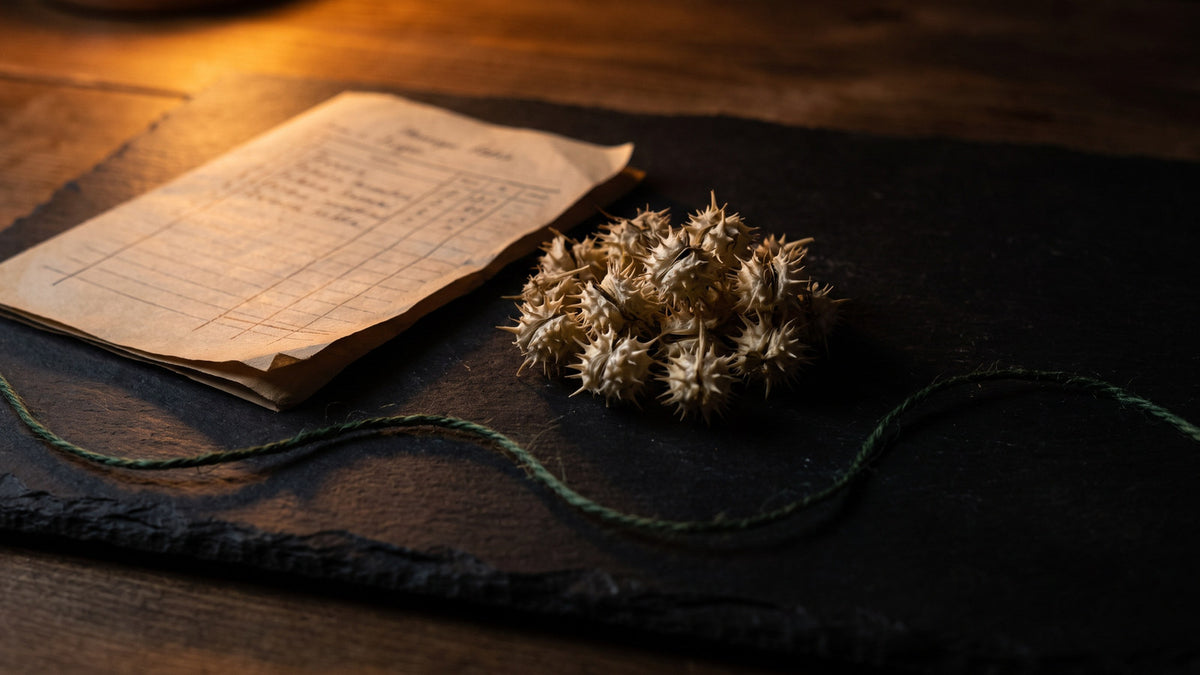
Tribulus terrestris L. is an annual herb of the caltrop family, Zygophyllaceae. It has a long branched taproot, trailing stems up to two metres long, small yellow five-petalled flowers, and a fruit that breaks into woody segments, each carrying two pairs of hard spines with one pair longer than the other. Those spines account for most of its English names: puncture vine, goathead, devil's thorn, caltrop.
The names multiply outside English. It is Gokshur in Sanskrit and Gokharu in Hindi, Nerinjil in Tamil, Bai Ji Li in Chinese practice, croix de chevalier in French. Search for 'gokshura' and search for 'tribulus' and you appear to be reading about two subjects. It is one plant.
Gokhru, gokshura and the two plants sold under one name
This is why the binomial is worth looking for. There is a working example in the Indian herb trade, where the word 'gokhru' covers two plants: chota, or small, gokhru is Tribulus terrestris, and bada, or large, gokhru is Pedalium murex, a plant of the sesame family that is not a close relative. A DNA study of marketed gokhru powders found a sample in which the labelled species accounted for 0.2 per cent of the sequence reads while Pedalium murex accounted for 61 per cent. The common name on that pack was accurate. The contents were something else.
UK food supplement rules ask for the name of the substance that characterises the product, or an indication of its nature, together with the amount present. They do not spell out that the Latin binomial has to be printed. A brand that prints it has answered a question the law did not force it to ask.
Which part of the tribulus plant is used, and how do you tell?
The second question is which part, and it is larger than it looks. The European Medicines Agency defines the herbal substance Tribulus terrestris L., herba as the dried, whole or fragmented flowering and fruit-bearing aerial parts of the plant. That is stems, leaves, flowers and fruit taken together. It is not the same material as the fruit alone, and neither of those is the root.
Why the fruit has a monograph and the herb does not
The three parts sit in very different places in the rulebook. The fruit has published monographs: the British Pharmacopoeia, the Japanese, Korean and Chinese pharmacopoeias, the Siddha and Ayurvedic pharmacopoeias of India, and a World Health Organization monograph, Fructus Tribuli, issued in 2009. The herb - the aerial parts - is the subject of no pharmacopoeia at all, in the EU or anywhere else. A pack that says fruit is pointing at a published identity standard a laboratory can test against. A pack that says aerial parts is pointing at whatever specification its supplier wrote.
In Ayurveda the plant is gokshura, and both the fruit and the root are used; the root is one of the ten roots of the Dashamoola group, and the fruit is widely substituted for it in practice.† In Chinese herbal practice the fruit is the part used.† Those are descriptions of tradition, and nothing more.
Composition follows the part. Analytical work reports that the smaller saponin molecules, the ones with short sugar chains, sit preferentially in the fruit, while the larger ones concentrate in the leaves and stems. Timing follows it too: saponin content in the aerial parts runs highest through the pre-flowering and flowering stages and falls away as the fruit sets. Harvest date is part of a specification, not a rustic detail.
Commercially the distinction decides cost and volume. Fruit has to be collected and cleaned off a low, spiny plant. Aerial parts can be cut and dried in bulk. Ours is Bulgarian, aerial parts and fruit, declared at 20 mg a tablet alongside five other botanicals, and it is on the label because otherwise you could not tell.
What does 'standardised to X% saponins' actually mean?
Start with what the plant contains. Published figures put the steroidal saponin content of Tribulus terrestris raw material between roughly 0.0015 and 2.9 per cent, varying with origin, plant part and stage of growth. A pack advertising 40 or 60 or 95 per cent saponins is therefore not describing a plant. It is describing an extract, and an extract is a manufactured thing.
That is what an extract ratio is for. A drug extract ratio, sometimes printed as 10:1, is the ratio between the quantity of plant material that went in and the quantity of extract that came out. Ten parts in, one part out. Because plants vary, a properly declared ratio is normally a range rather than a round number, and it is declared next to the extraction solvent, because the solvent decides which constituents come across. The one tribulus preparation on the European medicines market is declared as a dry extract of the herb, DER 35-45:1, extraction solvent methanol 80 per cent, containing not less than 45 per cent furostanol saponins calculated as protodioscin. That is four pieces of information. '10:1 extract' is one.
Protodioscin is the compound most often named. It is a furostanol saponin, and it is the marker the East European and West Asian material is characterised by: one recognised chemotype of the species has protodioscin and a sulphur-containing saponin, prototribestin, as its dominant constituents, while material from India and Vietnam runs to a different dominant saponin altogether. Same species, different chemistry, and the country of origin on a pack is a rough proxy for which of the two you have.
Colorimetry, chromatography and two different percentages
Now the measuring. 'Total saponins' is usually a colorimetric assay: a reagent is added, the sample changes colour, and the intensity of the colour is read off. It is cheap, and it is not specific, so compounds that are not the target can lift the result. Protodioscin has to be measured compound by compound, which means chromatography. Most saponins carry no chromophore, so ordinary ultraviolet detection is insensitive, and the reference method for tribulus used evaporative light scattering detection instead, reading protodioscin down to 10 micrograms per millilitre. A total-saponin percentage and a protodioscin percentage are two different quantities from two different instruments. They are not interchangeable, and a label rarely says which one it is quoting.
The phrase 'calculated as protodioscin' is worth pausing over. It does not say the extract is 45 per cent protodioscin. It says the total furostanol saponin content, whatever the mixture, has been expressed in protodioscin equivalents. It is an accounting convention, and a more honest one than a bare percentage, because it names the reference compound.
What all this adds up to has been measured directly. The study that developed the chromatographic method also ran it across products already on sale and found protodioscin content varying from 0.17 to 6.49 per cent. Two packs can both say 40 per cent saponins and hold quantities of the named marker differing by a factor of thirty. Neither is lying. They are answering different questions.
| What the label says | What it tells you | What it does not |
|---|---|---|
| Tribulus terrestris L. | The species, unambiguously | Which part, which origin, how much |
| Fruit, or fructus | The part used, and that published pharmacopoeia monographs exist for it | Whether the material was tested against one |
| Aerial parts, herb, or herba | The part used: the above-ground flowering and fruiting plant | Any published identity standard - no pharmacopoeia covers the herb |
| Extract 10:1 | Ten parts of plant material went in for one part of extract | The solvent, which constituents were concentrated, or what was added after extraction |
| Standardised to 40% saponins | An extract adjusted against a total-saponin assay | Which assay, and how much of the total is protodioscin |
| 45% furostanol saponins calculated as protodioscin | Total furostanol saponins expressed in protodioscin equivalents | The actual protodioscin figure |
| Bulgarian | Geographic origin, which tracks with a known chemotype | The plant part, the strength, or that any batch was tested |
What must a UK tribulus label say, and what can you ask for?
The Food Supplements (England) Regulations 2003 set out what has to appear on the pack. Six items:
- the name of the substance with a nutritional or physiological effect that characterises the product, or an indication of its nature;
- the portion recommended for daily consumption;
- a warning not to exceed that stated daily dose;
- a statement that supplements are not a substitute for a varied diet;
- a statement to keep the product out of the reach of young children;
- the amount of that substance present, per recommended daily portion.
Read the list again and notice what is missing. Nothing requires the plant part, the extract ratio, the extraction solvent, the assay method or the country of origin. Every fact that would let you compare one tribulus pack with another is optional. Spain's food safety committee, having reviewed tribulus in supplements, concluded that the part of the plant used, whether it was extracted or otherwise prepared, and its saponin content should all be made clear on the supplement itself. That is a recommendation from one member state rather than GB law, and it is a fair description of what a useful tribulus label would carry.
On claims the position is short. Tribulus holds no authorised health claim in Great Britain. Twelve claim statements covering the fruit and fruit extracts were put to the European Food Safety Authority for assessment; three were assessed and rejected, and the rest are unresolved, sitting with the wider set of botanical claims that have been on hold since 2010. A pack may describe what the plant is and how it has traditionally been used, marked as tradition. It may not say what it does.
What the safety record says, and what it leaves open
Safety sits on a separate shelf again, and it is not settled. The whole plant appears in the European Food Safety Authority's compendium of botanicals reported to contain naturally occurring substances of possible concern, on the basis of beta-carboline alkaloids at 40 to 80 mg per kg of dry matter among other constituents. That compendium is a hazard-identification list rather than a safety verdict, and its authors say so. Spain's committee concluded there was not enough toxicological data to assess the safety of tribulus plant parts in food supplements. Denmark could not establish a safe intake level and does not permit such supplements; Ireland treats tribulus products as medicinal; France requires the plant parts to be boiled; Italy allows them without restriction. Great Britain sells them as food. The World Health Organization does not recommend intake in children under 12. None of that is a verdict on any particular pack. It is why the do-not-exceed line on the back matters more here than it does on a tub of vitamin C.
If the label does not answer, ask. Five questions cover it:
- which part of the plant - fruit, aerial parts, root, or a mixture, and in what proportion;
- the extract ratio and the extraction solvent, or confirmation that the material is dried plant rather than an extract;
- whether the percentage on the front is total saponins or a named marker, and by which method;
- the protodioscin figure, if one is claimed, and the laboratory report behind it;
- the country of origin, and the batch code the paperwork is filed against.
Those are the general rules for reading the back of a pack, applied to one plant. A seller who can answer all five has the paperwork. A seller who answers none may still have it, but you have no way of knowing, which comes to the same thing at the point of purchase. Our own figures are on the carton - Tribulus terrestris 20 mg, Bulgarian, aerial parts and fruit - and the batch code on the blister foil will fetch the certificate for your pack from hello@maleup.co.uk.
Tribulus is an unusually good test of a label, because so much of it is optional. The species, the part, the ratio, the solvent, the assay and the origin are six facts, and a pack can lawfully print none of them. What does get printed is a choice, and the choice tells you who wrote the copy.
- Tribulus terrestris L. is one species with many names - gokshura, gokhru, puncture vine, Bai Ji Li.
- The fruit has pharmacopoeia monographs; the aerial parts (herba) have none anywhere.
- Raw plant runs about 0.0015-2.9% saponins, so any figure in the tens describes an extract.
- Total saponins and protodioscin are different quantities from different instruments.
- A UK pack must print six things, and the plant part, ratio, solvent and assay are not among them.
Common questions
What is tribulus terrestris?
Tribulus terrestris L. is an annual herb in the caltrop family, Zygophyllaceae, with trailing stems, small yellow five-petalled flowers and a spiny fruit that gives it English names such as puncture vine, goathead and caltrop. It grows across southern Europe, Asia and Africa. It holds no authorised health claim in Great Britain, so nothing is said here about what it does.
Is gokshura the same thing as tribulus?
Gokshura is the Sanskrit name for the same plant, and Gokharu is the Hindi form. In the Indian herb trade the word covers two plants: chota, or small, gokhru is Tribulus terrestris, while bada, or large, gokhru is Pedalium murex, an unrelated species of the sesame family. That is one good reason to look for the Latin binomial on a pack.
Which part of the tribulus plant is used in supplements?
Three parts are traded and they are not equivalent. The fruit has monographs in the British, Japanese, Korean and Chinese pharmacopoeias, the Siddha and Ayurvedic pharmacopoeias of India, and a World Health Organization monograph. The aerial parts, defined as the flowering and fruit-bearing above-ground plant, have no pharmacopoeia anywhere. The root is used separately. A label that omits the part leaves the main question open.
What does 'standardised to 40% saponins' mean on a tribulus pack?
It means an extract has been adjusted against a total-saponin assay, usually a colorimetric one that is cheap and not specific to saponins. Raw plant material runs at roughly 0.0015 to 2.9 per cent saponins, so any figure in the tens describes an extract rather than a plant. It does not tell you how much protodioscin is present, or by which method anything was measured.
What is a typical tribulus dosage on a UK pack?
There is no UK reference intake for tribulus and no authorised claim, so the only figure that governs is the pack's own recommended daily portion and its do-not-exceed line. A Spanish survey of notified supplements found declared extract amounts between 250 and 1,500 mg. AllMaleUp declares Tribulus terrestris 20 mg in a 100 mg six-botanical tablet. The figures are not comparable without the plant part and extract ratio.
Does tribulus terrestris have side effects?
No claim about effects is made here, in either direction. On the record: the whole plant appears in EFSA's compendium of botanicals reported to contain naturally occurring substances of possible concern, and Spain's food safety committee concluded there is not enough toxicological data to assess the safety of tribulus plant parts in supplements. The World Health Organization does not recommend intake under 12. Follow the pack's do-not-exceed line.
- Assessment report on Tribulus terrestris L., herba (EMA/HMPC/886105/2022) — EMA
- Report on the risk of using Tribulus terrestris in food supplements — AESAN (Spain) Steroidal saponin content of raw plant material between 2.9% and 0.0015%.
- HPLC determination of steroidal saponins in Tribulus terrestris — Journal of Pharmaceutical Sciences 2001 Market products varied 0.17–6.49% protodioscin.
- Distribution of steroidal saponins in Tribulus terrestris from different regions — Phytochemistry 69 (2008)
- Food Supplements (England) Regulations 2003, regulation 6 — legislation.gov.uk
- Declaration of herbal substances and preparations — drug-extract ratio — EMA
Six botanicals, 100 mg per tablet, every weight printed on the carton: Ginseng 25 mg, Maca 25 mg, Tribulus 20 mg, Guarana 10 mg, Ashwagandha 10 mg, Catuaba 10 mg. Maximum one tablet in any 24-hour period. Pressed in the UK on a GMP-registered line.
See the packs →† Describes the traditional use of these botanicals (UK 'on-hold' botanical claims under retained Regulation (EC) 1924/2006). Not authorised EFSA health claims. AllMaleUp is a food supplement, not a medicine.