

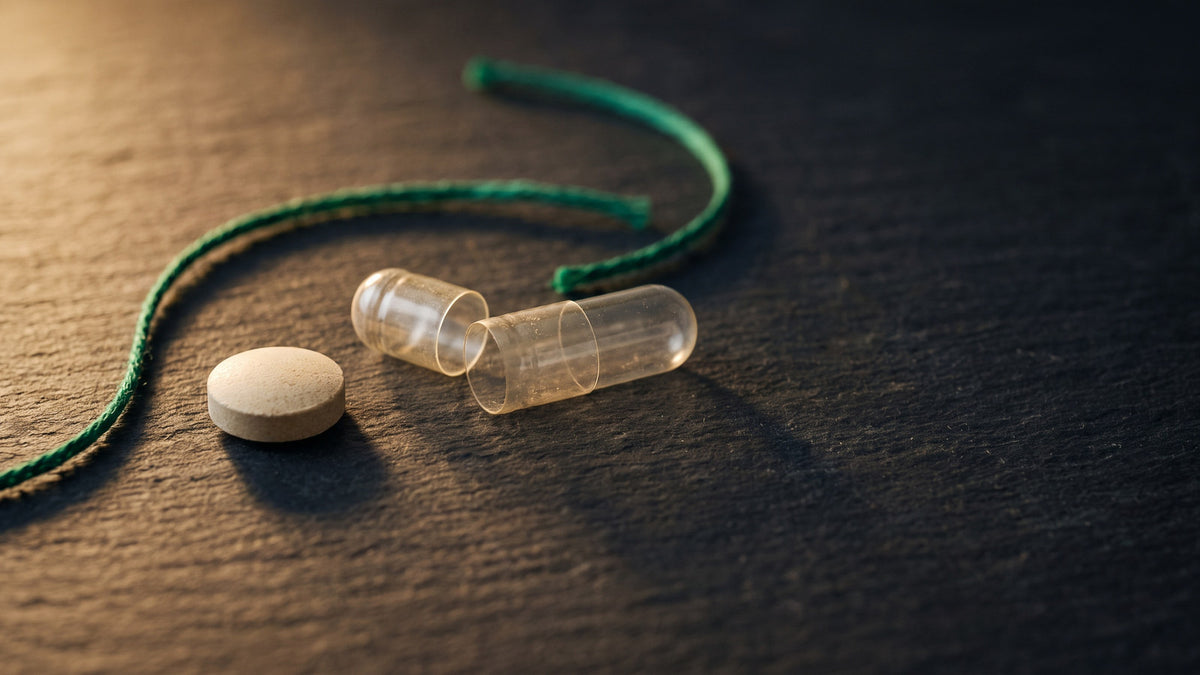
A tablet is powder compressed into a solid compact. A capsule is powder filled into a shell that was made first. The tablet needs a binder and a lubricant to survive the press; the capsule needs a shell of gelatin or hypromellose. Count the whole unit rather than the fill and neither ingredient list is obviously shorter.
No one has shown that either format is better for the person taking it. Disintegration is a repeatable production test run in a beaker, not a prediction about a body, and the published tablet-versus-capsule comparisons contradict each other. AllMaleUp is a tablet for manufacturing reasons - a small dense compact, a blister strip, no animal shell, a lower cost per unit - and for no other.
A tablet and a capsule can hold the same six plants at the same weights and still be two different objects. The difference is not what is inside them. It is how the thing was made, and what had to be added in order to make it.
That is worth setting out plainly, because the aisle sells the choice as a matter of quality. It is not. It is a manufacturing decision, taken in a factory, and both routes carry a cost that shows up on the label if you read it.
What is the difference between a tablet and a capsule?
Start with the machines, because everything else follows from them.
A tablet is made by compression. Blended powder drops into a steel die, two punches close on it, and the load turns loose material into a single solid compact, which is then pushed back out of the die. Nothing holds a tablet together except that pressure and the bonds it creates between particles.
That process makes three demands on the powder. It has to flow into the die evenly, or the tablets come out at different weights. It has to bond under load, or the compact crumbles on the way to the pack. And it has to release from the die wall on the way out, or it sticks and the run stops. Those three demands are the reason a tablet blend carries a lubricant, a binder and usually a glidant. They are there to serve the press, not the person taking the tablet. Magnesium stearate, the most widely used lubricant in the trade, earns its place because it improves the flow of a powder blend even at the very low percentages normally added.
How a capsule is filled without any compression
A capsule is made by filling. A two-piece shell arrives already formed, as a body and a cap. The body is dosed with powder - lightly tamped into a plug, or metered in by an auger - the cap is pushed down over it, and the joint is locked or banded shut. There is no compaction step of the kind a press applies. The fill never has to bond to itself and never has to survive being ejected from a die.
Because of that, a capsule fill can be a shorter list than a tablet blend. A brand filling capsules can sometimes get away with milled plant material and a flow aid and nothing else. That is a real advantage of the format, and it is the one capsule brands are right to point at.
Do capsules really contain fewer added ingredients?
The catch is that the comparison is almost always drawn in the wrong place. Setting a capsule fill against a tablet blend is not like for like, because the shell is part of the capsule and the shell is made of something.
Gelatin or HPMC: the shell is an ingredient too
Hard shells come in two main materials. Gelatin is a protein rendered from animal collagen. Hypromellose - usually written HPMC, and derived from plant cellulose - is the standard vegetarian alternative, and some hypromellose shells also carry a gelling agent such as carrageenan to help them set. On top of the base material, most shells carry a colour or an opacifier, because a shell has to look like something.
All of those are ingredients. A food supplement in the UK is a food, and what is in a food has to be declared on the pack, shell materials included. Count the whole unit rather than the fill and the gap between the two formats narrows. In some products it closes.
None of that makes capsules the worse buy. It makes the usual line - capsules have fewer additives - a statement about half of the product. The honest version is duller. A tablet needs processing aids that the powder on its own would not need. A capsule needs a container that the powder on its own would not need. Which of those two lists you would rather have is a preference, and it is not a ranking. The way to settle it for any given product is the one that always works: read the back of the pack and count what is actually declared there.
One thing does follow cleanly, though. A gelatin shell is an animal product, and a tablet has no shell at all. Ours are vegetarian-friendly partly for that reason - there is no shell decision to get wrong.
Which format copes better with damp, and which can be split?
Three practical differences survive scrutiny. They are worth knowing because they are the ones you can verify yourself, on a pack, without taking anyone's word for anything.
The first is how much material fits into one unit. A capsule is a fixed container: the shell size sets the volume, and the powder settles into it at whatever bulk density it happens to have. A tablet is compacted, so the same weight of material takes up less room. For a bulky blend that is the difference between asking someone to take one unit and asking them to take two. For our blend it is not a factor at all - 100 mg of milled plant material is a small quantity by either route - and we would be overstating our case if we pretended it had driven the decision.
Moisture: what a gelatin shell holds and a tablet does not
The second is water, and this one has actually been measured. Gelatin shells hold a great deal of it: figures in the region of 13 to 16 per cent water content are normal for gelatin, against roughly 4.5 to 6.5 per cent for hypromellose. That is not a fault. The water is what keeps a gelatin shell flexible. But it does mean the shell answers to the room it is kept in. Dried out, gelatin turns brittle. Left somewhere damp, it softens. Hypromellose sits at a much lower water content and is less troubled either way. A pressed tablet is a dry compact with no shell to plasticise in the first place, which is part of why dosage-form guidance written by manufacturers tends to put tablets on the steadier side of the comparison. It is also why packaging deserves more attention than the format argument gets: a sealed blister cavity keeps room air away from a tablet and a capsule alike.
The third is divisibility. A scored tablet can be broken in half. A capsule cannot be divided without opening it and losing most of the dose down the sink. That matters in medicine, where doses are adjusted by halves. It does not apply here. Our instruction is a maximum of one tablet in any 24-hour period, taken whole, and there is no half dose to go looking for.
Is a capsule better than a tablet?
This is where the category overreaches, so it is worth being exact about what is known and what is not.
There is a standard test called disintegration. A unit is placed in a tube in a basket, the basket is raised and lowered in water held at around body temperature, and the time is recorded until nothing is left but a soft mass with no firm core. The United States Pharmacopeia publishes a version of the chapter written specifically for dietary supplements. It is a useful, repeatable production check. It tells a manufacturer whether this batch is behaving like the last one.
What it does not tell anybody is what happens in a person. It is a beaker, a mesh and a motor, and it was designed to be exactly that: a control, not a prediction. Treating a disintegration time as a statement about a human being is the single most common mistake in this argument, and it is made by brands on both sides of it.
Why the published comparisons contradict each other
And the published comparisons do not agree with each other, which is the part that usually gets left out. One study set out to find a technological reason to choose one format over the other and found that for a poorly wettable compound at a high load, only the tablet gave a fast dissolution rate. Another, working with wax matrix granules of paracetamol, found the opposite - the capsules released faster than the tablets pressed from the same granules - and then found that adding ordinary diluents to the tablet reversed the ranking again. Both were done on single medicinal compounds rather than a botanical blend, which is a further reason not to carry either result across to a pack of plants.
So there is no general answer, and a journal that pretended otherwise would be doing the thing it criticises. Anyone who tells you flatly that capsules are taken up better than tablets is going past what has been shown. We are not going to tell you the reverse either. AllMaleUp is a food supplement, not a medicine, and none of the six plants in it holds an authorised health claim in Great Britain.
UK law is consistent with that, incidentally. The Food Supplements (England) Regulations 2003 define a food supplement as a food sold in dose form, and then govern what may go in it and what the label must say. They set no requirement at all for how quickly the dose form has to break up. A brand may run the test as part of its own release checks, and a brand that says nothing about it is not breaking a rule.
Our own choice was a tablet, and the reasons are ordinary. A compact of 100 mg of milled plant material is small, dense and dry, which suits a blister strip better than a shell does. Compression is the cheaper of the two processes at the scale we work at, which is part of why the pack costs what it does rather than more. There is no shell to source, so the animal-or-plant question never arises. And the line that presses them is a GMP-registered site in the UK, which is the part we would rather be judged on.
None of those are reasons to think a tablet does more. They are reasons a tablet was the easier thing for us to make well. If a brand's answer to why this format is anything other than a manufacturing answer, ask what the evidence for it is - and then go and read the ingredient list, because that is where the answer has to be.
- A tablet is compressed under load in a die; a capsule is filled into a pre-formed shell, with no compaction step at all.
- Tablet blends carry a lubricant, a binder and usually a glidant - excipients that exist to serve the press, not the person.
- A capsule fill can be a shorter list, but the shell is an ingredient too: gelatin is an animal protein, hypromellose (HPMC) is plant cellulose.
- Gelatin shells hold roughly 13-16% water against about 4.5-6.5% for hypromellose, so they turn brittle when dry and soften when damp.
- Disintegration is a pharmacopoeial production check, not a statement about a person, and the published format comparisons disagree with each other.
Common questions
What is the difference between a tablet and a capsule?
A tablet is made by compression: blended powder is fed into a steel die and pressed into a single solid compact. A capsule is made by filling: powder is dosed into a shell body that was formed beforehand, and a cap is closed over it. The difference is the manufacturing route, and everything else - which excipients are needed, how dense the unit is, how it behaves in a damp cupboard - follows from that.
Do capsules have fewer added ingredients than tablets?
The fill often does. A tablet blend needs a lubricant so the compact releases from the die, a binder so it holds together and usually a glidant so the powder flows, and a capsule fill needs none of those. But the shell is part of the capsule and is made of gelatin or hypromellose, commonly with a colour or an opacifier and sometimes a gelling agent. Under UK food law all of that has to be declared. Counting the whole unit rather than the fill narrows the gap and can close it.
Is a capsule absorbed better than a tablet?
That has not been established, and the published work points both ways. One study found that for a poorly wettable compound at a high load only the tablet gave a fast dissolution rate; another, using wax matrix granules of paracetamol, found the capsules released faster than tablets pressed from the same granules, and that adding ordinary diluents to the tablet reversed the ranking again. Both used single medicinal compounds rather than botanical blends. Any brand stating a general rule here is going past the evidence.
Why is AllMaleUp a tablet rather than a capsule?
For manufacturing reasons, not for any claimed advantage. A compact of 100 mg of milled plant material is small, dense and dry, which suits a sealed blister strip. Compression is the cheaper of the two processes at our scale. There is no shell to source, so the animal-or-plant question never arises and the tablet is vegetarian-friendly by default. The tablets are pressed in the UK on a GMP-registered line.
Are tablets or capsules better in a warm or damp house?
Gelatin shells hold a lot of water - figures around 13-16% are normal, against roughly 4.5-6.5% for hypromellose - and that water is what keeps them flexible, so a gelatin capsule turns brittle when it dries out and softens when it is kept somewhere damp. A pressed tablet has no shell to plasticise. In practice the packaging matters more than the format: a sealed blister cavity keeps room air away from either one, and both should be stored below 25 degrees C, out of direct sunlight.
Are capsules suitable for vegetarians?
Only if the shell is. Gelatin is a protein rendered from animal collagen, so a gelatin capsule is not vegetarian. Hypromellose, or HPMC, is derived from plant cellulose and is the usual vegetarian alternative. The pack has to say which one it uses. A tablet has no shell, which is one of the reasons ours are vegetarian-friendly.
- General Chapter 〈2040〉 Disintegration and Dissolution of Dietary Supplements — United States Pharmacopeia (USP-NF) The disintegration chapter written specifically for supplement tablets and capsules.
- The Food Supplements (England) Regulations 2003 (SI 2003/1387) — legislation.gov.uk Defines a food supplement as a food sold in dose form; sets no disintegration requirement.
- Search for technological reasons to develop a capsule or a tablet formulation with respect to wettability and dissolution — International Journal of Pharmaceutics, 2004 (von Orelli & Leuenberger) For a poorly wettable compound at high load, only the tablet gave a high dissolution rate.
- A comparative study of the dissolution characteristics of capsule and tablet dosage forms of melt granulations of paracetamol - diluent effects — Acta Poloniae Pharmaceutica, 2007 (Uhumwangho & Okor) The opposite result: capsules 0.31 min-1 against tablets 0.20 min-1, reversed by adding diluents.
- The effect of lubricants on powder flowability for pharmaceutical application — AAPS PharmSciTech, 2013 (Morin & Briens) Magnesium stearate gave the best improvement in flowability at the low levels normally used.
- What Are Excipients? 9 Common Examples — Colorcon Roles of binders, lubricants, glidants and disintegrants in tablet compression.
- Tablet vs Capsule: A Guide to Choosing the Best Dosage Form — Colorcon Manufacturer's view: tablets generally cheaper to produce, more resistant to moisture, and scorable.
- Comparative Evaluation of Gelatin and HPMC Inhalation Capsule Shells Exposed to Simulated Humidity Conditions — Pharmaceutics, 2025 (Magramane et al.) Measured on inhalation capsules; the shell moisture figures are quoted here as typical of the two shell materials, not of oral capsules specifically.
Six botanicals, 100 mg per tablet, every weight printed on the carton: Ginseng 25 mg, Maca 25 mg, Tribulus 20 mg, Guarana 10 mg, Ashwagandha 10 mg, Catuaba 10 mg. Maximum one tablet in any 24-hour period. Pressed in the UK on a GMP-registered line.
See the packs →† Describes the traditional use of these botanicals (UK 'on-hold' botanical claims under retained Regulation (EC) 1924/2006). Not authorised EFSA health claims. AllMaleUp is a food supplement, not a medicine.