

The reference sources record very little. Memorial Sloan Kettering's maca monograph states under adverse effects that "side effects have not been reported", while its professional section lists subjective reports of moodiness, gastritis and insomnia. The USP safety review searched the FDA, MHRA, Canadian, Australian, WHO and European databases to July 2009: the 22 FDA MedWatch reports it found "all" involved multi-ingredient products containing maca as one component, and a PubMed search returned no case reports at all. An empty database is weak evidence rather than strong evidence, because spontaneous reporting captures only what somebody filed.
Three cautions do appear in the sources, and all three are conditional: glucosinolates combined with low iodine in people with thyroid disorders, prescribed medicines (vitamin K and anticoagulants, SSRIs, an animal finding with losartan), and pregnancy and breastfeeding. The quantities behind the record also matter. The human studies used 1.5 to 3 grams of dried root a day and Andean food use is estimated at 50 to 100 grams a day, while one AllMaleUp tablet contains 25 mg of maca, one of six botanicals adding to 100 mg in total, with a maximum of one tablet in any 24-hour period. A smaller figure is disclosure, not a conclusion in either direction.
Type maca side effects into a search box and the answers come back shaped like a medicines leaflet: a list of symptoms, a list of people who should avoid it, a note about interactions. The shape is borrowed, and it does not quite fit. Maca is not a compound with a marketing authorisation behind it. It is a root vegetable in the cabbage family, grown and eaten in the Peruvian Andes for centuries, and the question of what it does to a person is tangled up with how much of it is being eaten and in what form.
That is the awkward part of this subject. Almost everything recorded about maca as a food was recorded about people eating large amounts of a cooked, dried root. Almost everything sold in the United Kingdom is a small amount of milled powder or a concentrated extract, pressed into a tablet. Those are not the same exposure. What follows is what the reference sources record, where the cautions come from, who issues them, and why the milligram figure on a pack — ours included — is not the figure the research was done on.
What is maca, and how much of it do people eat?
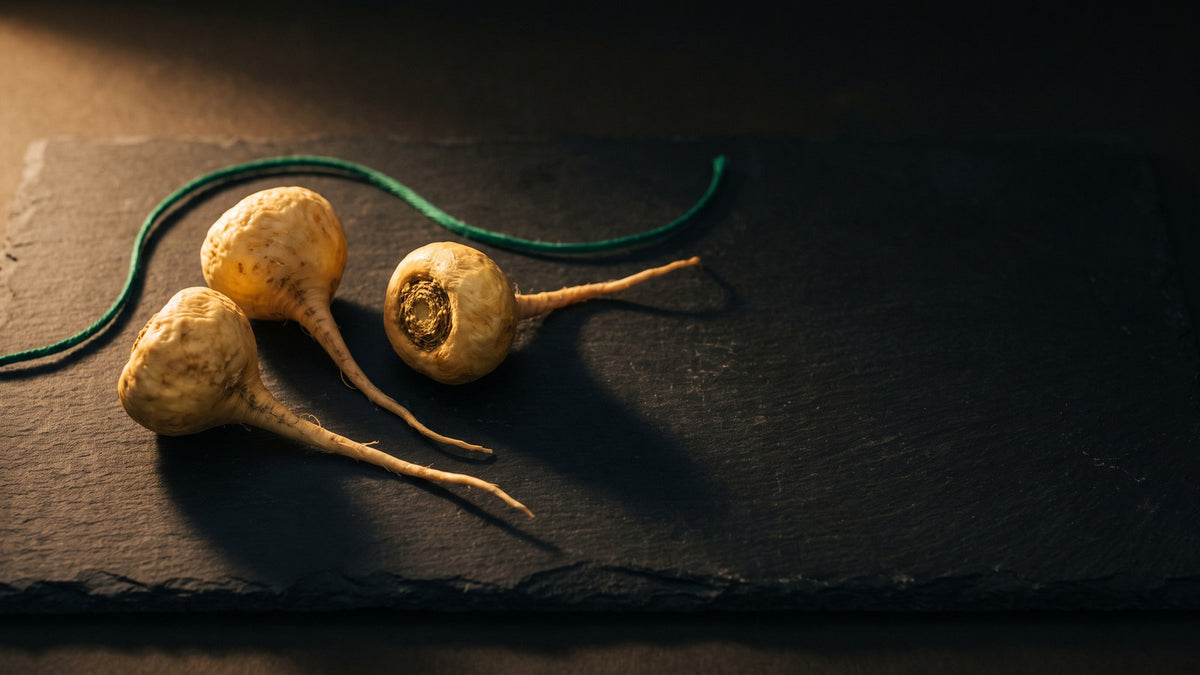
Lepidium meyenii belongs to the Brassicaceae, the family that also holds cabbage, broccoli, mustard, turnip and rocket. The part used is the hypocotyl, the swollen structure between stem and taproot, and the United States Pharmacopeia's proposed definition is about as plain as botany gets: "Maca consists of the dried hypocotyls of Lepidium meyenii Walp. (Fam. Brassicaceae)."
It is grown on the Junín plateau in central Peru, where it is a staple crop rather than a specialist herb. The scale of ordinary consumption is the number that reframes this entire topic. The USP safety review cites an estimate of roughly 50 to 100 grams of dried hypocotyl per day eaten as food in the middle Andean region, against a dietary-supplement dose range it gives as 1.5 to 3 grams of dried hypocotyl. The food portion is something like twenty to seventy times the supplement portion, and it has been eaten that way, by whole communities, since at least 1549 by the USP's own dating.
The traditional preparation is the part that usually goes missing from the discussion. Maca is dried in the open air for weeks after lifting, and then it is cooked. The USP Dietary Supplements Expert Committee describes traditional practice as including "roasting or cooking in milk or water", and notes in the same paragraph that "the commercially available dietary supplement dosage forms are not in the form described in traditional practice". A 2024 review in Frontiers in Pharmacology is blunter still: it records that Andean growers "advise consuming only dehydrated maca root", and that "fresh maca can be harmful to health".
Raw powder is not the traditional preparation
Raw maca powder, in other words — the tub sold as a smoothie ingredient — is not the traditional article, and the traditional record of tolerability was not built on it. That is not a claim that raw powder is harmful. It is a claim that the centuries of food use which get cited in its defence were not centuries of eating it raw.
The drying is not merely a storage step either. The same 2024 review attributes the macamides, the compounds most often used as maca's chemical signature, to post-harvest drying, involving hydrolysis of lipids and of glucosinolates. Dried root and fresh root are chemically different articles. So a question about maca's effects is always, underneath, a question about which maca.
What maca side effects have actually been reported?
Memorial Sloan Kettering Cancer Center publishes one of the more conservative herb monographs in circulation. Its maca entry states, under adverse effects, that "side effects have not been reported". Its professional section is less tidy and more useful: it lists subjective reports of moodiness, gastritis and insomnia among others. Those are reports rather than findings, and the monograph presents them as such.
The adverse-event databases have been searched properly at least once, and the result repays reading in full. The USP safety review searched them to July 2009. FDA MedWatch returned 22 reports for the period from January 2001, of which 18 were non-serious and four serious; the review states that "All the reports involved multi-ingredient products containing maca as one of the components." The four serious ones are worth stating rather than summarising. Two involved a multi-ingredient weight-loss product carrying an undeclared amount of maca; of those two, one patient died and the other had a stroke and a long hospital stay. The third had an anaphylactic reaction while also taking a herbal cleansing product and was discharged the same day. The fourth was admitted with a slow heart rate after seven to ten days of another multi-ingredient product, having previously had a heart valve replaced. The British MHRA database held two reports as of September 2009, neither fatal, covering palpitations, convulsion and urticaria. Canada's programme held ten, Australia's TGA five across the years 1960 to 2009. Searches of the European Medicines Agency, EFSA, the World Health Organization and New Zealand's Medsafe returned nothing. A PubMed search found no case reports of adverse reactions to maca-based products at all.
Why a near-empty adverse-event database proves little
Two conclusions pull against each other there, and both are worth holding. Very little has been reported, across several national systems, over roughly a decade. And almost nothing that was reported can be attributed to maca, because the products involved contained several ingredients and in one instance an undeclared quantity of maca in a weight-loss product. Spontaneous reporting systems also undercount by design: they capture what somebody thought to file. An empty database is weak evidence, not strong evidence, and it is the evidence available.
The trial record is small and mostly unremarkable. The USP review cites work by Gonzales and colleagues in which no adverse effects were observed in healthy volunteers given 1.5 or 3 grams a day for four months, and a study by Dording in which 3 grams a day was well tolerated in sixteen people. Unpublished studies cited by the Australian and New Zealand regulators reported only mild headache and flushing. The one signal in the set comes from a small randomised study in patients with metabolic syndrome given 0.6 grams a day for more than ninety days: the maca-only group showed higher aspartate transaminase and higher diastolic blood pressure than the group given maca with silymarin, and the authors suggested caution at higher doses in people with hypertension. The 2024 Frontiers review summarises the whole picture as a "good safety profile" with "no fatal adverse effects" reported. That phrase has to be read against the FDA set above, which did include a death - in someone taking a weight-loss product whose maca content was undeclared. Both statements are accurate about the thing their authors were describing, and the distance between them is the whole difficulty of this subject: what gets attributed to a plant depends on what else was in the packet.
Who do the sources tell to take advice first?
The thyroid caution is a glucosinolate caution, and it applies to maca for the same reason it applies to sprouts. Glucosinolates are the sulphur-containing compounds characteristic of the Brassicaceae; maca's are mainly glucotropaeolin, and the USP review notes that the particular combination of sinigrin and glucotropaeolin is unique enough to maca to be used as a chemotaxonomic marker. The caution the review then prints is conditional and precisely worded: "Excess consumption of glucosinolates, coupled with low iodine levels, could precipitate goiter in those with thyroid disorders."
The thyroid caution is about glucosinolates and low iodine
Both halves of that sentence matter. The Nordic Nutrition Recommendations scoping review on iodine sets out the mechanism — goitrogens "can inhibit the uptake of iodine into the thyroid gland (e.g. thiocyanates) or interact with hormone production (e.g. goitrins)" — and then sets out the scale: "The levels of glucosinolates in most diets are generally too low to have an impact on iodine status." So the concern attaches to unusual quantities in people whose iodine intake is already low or whose thyroid is already under treatment, rather than to cruciferous plants generally. Anyone in that position is being told by these sources to take advice before adding a concentrated form of any Brassica, not to panic about broccoli.
The second caution is about prescribed medicines, and it has three separate threads. The USP review notes that maca carries a high concentration of vitamin K, common across the Brassicaceae, "therefore it is possible that the consumption of maca could adversely affect bleeding parameters in patients taking anticoagulant medication (e.g., warfarin)". It flags a possible interaction with SSRI antidepressants on the basis of a single study. Memorial Sloan Kettering records that maca was shown to add to the blood-pressure-lowering effect of losartan in hypertensive rats — an animal finding, in a monograph that says so. The same monograph advises anyone with a hormone-sensitive cancer to speak to their clinician first.
The third caution sits outside this readership, and is printed here as the sources print it. Memorial Sloan Kettering: "Talk to your healthcare provider if you're pregnant or breastfeeding. Maca may not be safe for you." The USP review records that the Natural Medicines Comprehensive Database advises avoiding maca in pregnancy and lactation because of the absence of safety information, while noting that no cautions of that kind appeared in several of the reference texts it reviewed. Our readership is men. The line is here because omitting it would be editing the source rather than reporting it.
How much maca is 25 mg, next to the studies?
Here is our own number, without softening. One AllMaleUp tablet contains 25 mg of maca, one of six botanicals adding to 100 mg in total, with a maximum of one tablet in any 24-hour period. The human studies described above used 1.5 to 3 grams of dried root per day. Twenty-five milligrams is somewhere between one-sixtieth and one-hundred-and-twentieth of those daily amounts, and food-scale consumption in the Andes is larger again by a wide margin.
We are not presenting that as an advantage, and we are not drawing a conclusion from it in either direction. A smaller quantity is not a claim of safety, and it is certainly not a claim of effect. What it is, is disclosed: the figure is printed on the carton to the milligram, the studies printed theirs, and the comparison belongs to the reader rather than to us.
Milled root and extract are not the same quantity of plant
The other half of the arithmetic is the form, and this is where most labels in this aisle stop being readable. Milled dried root and a concentrated extract are measured in the same unit and are not the same quantity of plant: a 10:1 extract represents ten times its own weight in raw material. The USP committee made the related point about chemistry rather than quantity, warning that "the use of material not prepared following traditional methods of preparation (e.g., ethanolic extracts) may contain components that would not normally be ingested when maca is eaten raw or prepared following traditional methods". So 500 mg on one pack and 500 mg on another can mean different amounts of root and a different chemical profile. A species, a plant part and a form turn a number into information. A number alone stays a number.
What a UK supplement label has to print is set out in regulation 6 of the Food Supplements (England) Regulations 2003: the amount of each substance per recommended daily portion, the portion itself, a warning not to exceed it, and a statement that supplements are not a substitute for a varied diet. What a label is not permitted to print is what the plant does to a body. None of the six botanicals in our blend holds an authorised claim in Great Britain; the GB Nutrition and Health Claims register lists what has been authorised and rejected, and botanical claims of this kind remain on hold under retained Regulation (EC) 1924/2006.
There is a second silence on the carton that people read as reassurance, and it is not one. A food supplement label carries no list of side effects, because a side-effect list is a medicines document — it belongs to a patient information leaflet, and a food supplement does not have one. The absence of that list says something about the regulatory category the product sits in. It says nothing whatsoever about the plant.
So the practical route, if you take prescribed medicines, have a thyroid condition, or have any diagnosed condition at all, is not a website. Take the pack to a pharmacist or your GP and let them read the ingredient list with the weights next to it, which is the reason the weights are printed there. The batch code and best-before date are on the blister foil, and the Certificate of Analysis for that batch is available from hello@maleup.co.uk if a clinician wants to see what was actually tested.
- Maca is Lepidium meyenii, a Brassicaceae root vegetable; the part used is the dried hypocotyl.
- Memorial Sloan Kettering records "side effects have not been reported", alongside subjective reports of moodiness, gastritis and insomnia.
- The USP review found 22 FDA MedWatch reports to July 2009, all of them for multi-ingredient products.
- The thyroid caution is conditional: excess glucosinolates plus low iodine in people with thyroid disorders.
- One AllMaleUp tablet holds 25 mg of maca; the human studies used 1.5 to 3 grams of dried root a day.
Common questions
What are the side effects of maca?
Memorial Sloan Kettering's monograph states under adverse effects that side effects have not been reported, and its professional section lists subjective reports including moodiness, gastritis and insomnia. The USP safety review found 22 FDA MedWatch reports to July 2009, all for multi-ingredient products containing maca as one component, two MHRA reports covering palpitations, convulsion and urticaria, ten Canadian reports and five Australian ones. A PubMed search returned no case reports of adverse reactions to maca-based products.
Is maca safe to take?
That is not a question this page answers, because a food supplement is not a medicine and we are not a clinician. What the sources record is this: the USP committee found no serious adverse events for single-ingredient maca products in its review, trials at 1.5 to 3 grams a day reported no adverse effects, and a 2024 review in Frontiers in Pharmacology describes a good safety profile with no fatal adverse effects reported. Set against that, reporting systems undercount and the cautions below are real. If you take prescribed medicines or have a diagnosed condition, ask a pharmacist or GP.
Does maca affect the thyroid?
The caution in the USP review is conditional and is really about the cabbage family: "Excess consumption of glucosinolates, coupled with low iodine levels, could precipitate goiter in those with thyroid disorders." The Nordic Nutrition Recommendations scoping review on iodine sets the scale, noting that levels of glucosinolates in most diets are generally too low to have an impact on iodine status. Anyone with a thyroid condition or a low iodine intake should take advice before adding a concentrated form of any Brassica.
Can I take maca with prescribed medicines?
Ask the person who prescribed them. The USP review notes that maca carries a high concentration of vitamin K, so consumption could adversely affect bleeding parameters in patients taking anticoagulant medication such as warfarin, and flags a possible interaction with SSRI antidepressants on the basis of a single study. Memorial Sloan Kettering records an animal finding with losartan in hypertensive rats, and advises anyone with a hormone-sensitive cancer to speak to their clinician first.
How much maca is in an AllMaleUp tablet?
One tablet contains 25 mg of maca, one of six botanicals adding to 100 mg in total, alongside Ginseng 25 mg, Tribulus 20 mg, Guarana 10 mg, Ashwagandha 10 mg and Catuaba 10 mg. The maximum is one tablet in any 24-hour period. For comparison, the human studies described in the reference sources used 1.5 to 3 grams of dried root a day, and Andean food consumption is estimated at 50 to 100 grams a day.
Why is there no list of side effects on the pack?
Because a side-effect list is a medicines document. It belongs to a patient information leaflet, and a food supplement does not have one. Regulation 6 of the Food Supplements (England) Regulations 2003 sets out what the label must carry: the amount of each substance per recommended daily portion, the portion itself, a warning not to exceed it, and a statement that supplements are not a substitute for a varied diet. The absence of a side-effect list describes the regulatory category, not the plant.
- USP Safety Review of Maca — USP Dietary Supplements Compendium, Dietary Supplements Expert Committee Definition, intake levels, adverse-event database searches to July 2009, cautions.
- Maca — herb monograph (adverse effects, interactions, purported uses) — Memorial Sloan Kettering Cancer Center
- Exploring the chemical and pharmacological variability of Lepidium meyenii: a comprehensive review of the effects of maca — Frontiers in Pharmacology, 2024 Dehydrated-root advice, macamide formation on drying, safety summary.
- Iodine: a scoping review for Nordic Nutrition Recommendations 2023 — Food & Nutrition Research, vol. 67 Goitrogen mechanism and the dietary scale of glucosinolate intake.
- Food Supplements (England) Regulations 2003, regulation 6 — legislation.gov.uk
- Great Britain nutrition and health claims (NHC) register — GOV.UK
Six botanicals, 100 mg per tablet, every weight printed on the carton: Ginseng 25 mg, Maca 25 mg, Tribulus 20 mg, Guarana 10 mg, Ashwagandha 10 mg, Catuaba 10 mg. Maximum one tablet in any 24-hour period. Pressed in the UK on a GMP-registered line.
See the packs →† Describes the traditional use of these botanicals (UK 'on-hold' botanical claims under retained Regulation (EC) 1924/2006). Not authorised EFSA health claims. AllMaleUp is a food supplement, not a medicine.