

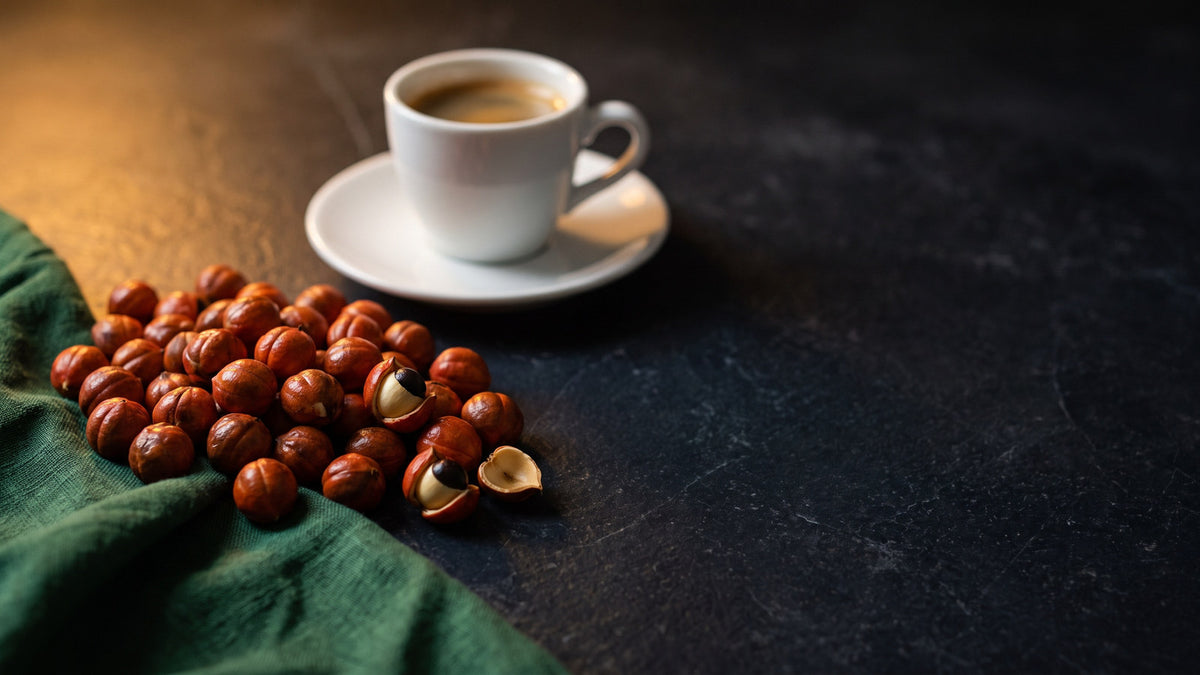
Guarana seed is one of the most caffeinated plant materials there is: published analyses put it at 2-8% caffeine by dry weight, against roughly 1-3% for a roasted coffee bean. Gram for gram that is about two to four times as much, not the six times often quoted.
The inclusion is small, so the number is small. Ten milligrams of guarana seed works out at roughly 0.2-0.8 mg of caffeine, and the AllMaleUp label declares under 5 mg per tablet as a conservative ceiling. A mug of instant coffee is about 100 mg, a mug of tea about 75 mg, and a cup of decaf 2-15 mg.
Guarana is the smallest thing on our label, joint with two others: 10 mg, level with ashwagandha and catuaba, inside a tablet that holds 100 mg of plant material in total. It is also the only one of the six that brings caffeine with it, which makes it the one ingredient where the number matters more than the description.
That number is under 5 mg of caffeine per tablet. Here is where the figure comes from, how it sits against what is already in your kitchen, and why most packs containing guarana never print it at all.
Does guarana have more caffeine than coffee?
Paullinia cupana is a climbing vine from the Amazon basin, and the seed is the part used. Ours is wild-harvested in the Maués region of Brazil. Caffeine is a methylxanthine - one of a small family of compounds that certain plants concentrate in their seeds and leaves - and guarana seed concentrates a great deal of it for its size.
What the published analyses actually say
Published analyses put the caffeine content of dried guarana seed somewhere between 2% and 8% of dry weight. That is a wide band, and it is wide for real reasons: cultivar, growing conditions, how the seed was dried and how it was measured all move the figure. Most of the analytical work clusters more tightly than the outer range suggests, between roughly 2.5% and 6%. A roasted coffee bean, measured the same way, sits at about 1% to 3%.
Set those side by side and guarana seed carries something like two to four times the caffeine of a coffee bean, gram for gram. You will see much larger multiples quoted - four times, six times, 'the most caffeinated plant on earth' - and they come from taking the top of one range and the bottom of the other. The honest answer is a range rather than a multiple, and the range is two to four.
Two cautions before that comparison gets carried too far. The first is that nobody consumes a gram of dry coffee bean either. A mug of coffee is brewed from several grams of ground bean; a tablet contains ten thousandths of a gram of guarana. Concentration and dose are separate questions, and it is the second one that decides what ends up in a pack.
Seed powder and extract are not the same 10 mg
The second is that 'guarana' on an ingredient list can mean two quite different materials. Milled seed is one thing. A concentrated extract, standardised to a far higher caffeine content, is another, and 10 mg of each would not give you the same number. This is one of the places where two labels can print identical words and mean different things, and it is why the caffeine figure is more useful than the botanical weight on its own.
How much caffeine does 10 mg of guarana give you?
Take the percentages literally. Ten milligrams of guarana seed at 2% caffeine is 0.2 mg. The same 10 mg at 8%, the very top of the published range, is 0.8 mg. Anywhere inside that band, the answer to 'how much caffeine is in the tablet' is under a milligram.
Our label declares under 5 mg. That is not the estimate. It is the ceiling, and it is deliberately set well above the arithmetic. A declared figure on a food supplement has to hold for every tablet in every batch, across seasonal variation in the raw material, variation between deliveries, and the tolerance of the test method itself. A ceiling drawn tight against the average would be broken by the first unusual harvest. Setting it at under 5 mg leaves room, and the room is the point.
The comparison most people actually want is not with a coffee bean. It is with a cup of something.
| Drink | Caffeine |
|---|---|
| Mug of instant coffee | about 100 mg |
| 250 ml can of energy drink | about 80 mg |
| Mug of black or green tea | about 75 mg |
| Can of cola | about 40 mg |
| Cup of decaffeinated coffee | about 2-15 mg |
| One AllMaleUp tablet | under 5 mg |
Where the comparison figures come from
The first four figures are the NHS's own, published in its guidance on caffeine during pregnancy. The decaffeinated range is the US Food and Drug Administration's. The NHS puts no number on filter coffee, noting only that filter coffee and coffee bought from coffee shops can contain more than instant. All of these are averages with wide spreads behind them, which is worth remembering before treating any of them as precise.
Decaffeinated deserves a line of its own, because it is a legal term rather than a plain-English one. It does not mean caffeine-free. Under the assimilated version of Directive 1999/4/EC, a coffee extract may be sold in Great Britain as decaffeinated provided its anhydrous caffeine content does not exceed 0.3% of the coffee-based dry matter. What survives that is small, but it is not nothing, which is why the FDA quotes a range rather than a single figure.
For scale at the other end of the shelf: the European Food Safety Authority's 2015 assessment of caffeine concluded that habitual intakes up to 400 mg a day, and single intakes up to 200 mg, do not raise safety concerns for healthy adults who are not pregnant, with 200 mg a day the corresponding figure in pregnancy. Those are risk-assessment numbers, not targets, and they are not a statement about this or any other product. They are simply the scale that a 5 mg ceiling sits on.
Do supplement labels have to declare caffeine content?
UK rules are specific about this. The Food Supplements (England) Regulations 2003 require the label to declare the amount of any vitamin, mineral or other substance with a nutritional or physiological effect present in the product, in numerical form, per portion as recommended for daily consumption. Caffeine is a substance with a physiological effect. If it is in the tablet, the amount is declarable.
The caffeine warning, and the threshold it starts at
There is a second rule that does not apply to us, but is worth knowing because it explains a good deal of packaging. Under Annex III of assimilated Regulation (EU) No 1169/2011, a food supplement containing caffeine above 150 mg per litre, added for a physiological purpose, must carry the words 'Contains caffeine. Not recommended for children or pregnant women' in the same field of vision as the name of the product, followed by the caffeine content per recommended daily portion. That threshold is drawn to catch caffeine tablets and pre-workout powders. A tablet holding under 5 mg is nowhere near it.
So why do so few blends containing guarana print the figure? Partly the proprietary blend problem. If the guarana sits inside a 500 mg total with no split declared, nobody can calculate the caffeine - including whoever wrote the label. Partly because guarana is declared as a botanical, listed alongside plants that carry nothing of the kind, and the caffeine never gets pulled out as its own line. And partly because the number is awkward. A pack that mentions caffeine invites a question. A pack that says nothing does not.
Very little of that is deliberate. Most of the time it is arithmetic nobody did. But a brand that cannot tell you the caffeine content of its own tablet has told you something about the state of its records, which is a different and more useful piece of information.
The practical consequence for you is narrow, and it is the whole of what we will say about it: the number is printed, so where the tablet goes in your day is a decision you can make with a figure in front of you rather than one we make for you. What the label does not do is tell you what that caffeine does. That is a different kind of statement, and it is not one being made here.
Why is guarana in energy drinks and soft drinks?
The Sateré-Mawé people of the Maués region have cultivated and prepared guarana for centuries. The seed is roasted, ground and grated into water, and the practice is old enough to sit inside their origin stories.†
The commercial soft drink came far later, and it did not work at first. Guaraná syrup was being processed in Brazil from around 1905, and an early bottled version appeared in Rio Grande do Sul in 1906, but the drink was astringent and bitter and went nowhere. The formula that succeeded was developed by Pedro Baptista de Andrade and sold to Companhia Antarctica Paulista, which found a way to strip the astringency and launched Guaraná Champagne Antarctica in 1921. It went on to become the second most consumed soft drink in Brazil after Coca-Cola, and guaraná has been a soft drink category there ever since.
The energy drink aisle picked the name up much later, and for a different reason. Guarana is a caffeine-bearing ingredient with a plant name attached to it, which is a useful thing to have on a can. Those drinks are then caught by a rule of their own. A beverage containing more than 150 mg of caffeine per litre, from any source, has to carry 'High caffeine content. Not recommended for children or pregnant or breast-feeding women' in the same field of vision as its name, with the caffeine content stated in mg per 100 ml - unless the drink is based on coffee or tea and says so in its name, in which case the name is treated as warning enough.
Which produces the oddity visible on any supermarket shelf. A can of energy drink carries a printed caffeine warning. A cup of filter coffee holding more caffeine than the can carries nothing, because it is called coffee and everybody already knows. The rule is about what a shopper can reasonably be expected to work out, not about the dose.
Guarana reached our tablet by the older route: as one of six plants with a long traditional record, declared at 10 mg, with everything that comes with it declared too.†
So: one tablet, 10 mg of guarana, under 5 mg of caffeine, a maximum of one tablet in any 24-hour period. Roughly a twentieth of a mug of instant coffee, arrived at by multiplying a small weight by a published percentage and then rounding conservatively upwards. Nothing more interesting than that, which is rather the point.
- Guarana seed: 2-8% caffeine by dry weight. Roasted coffee bean: roughly 1-3%.
- Gram for gram that is about two to four times, not six.
- 10 mg of guarana seed works out at roughly 0.2-0.8 mg of caffeine.
- The label declares under 5 mg per tablet - a ceiling that must hold for every batch.
- UK rules require substances with a physiological effect to be declared per daily portion.
Common questions
How much caffeine is in guarana?
Published analyses put dried guarana seed at between 2% and 8% caffeine by dry weight, with most analytical work clustering between about 2.5% and 6%. The band is wide because cultivar, growing conditions, drying method and test method all move the figure. What matters on a pack is not the percentage but how many milligrams of guarana are actually in it.
Does guarana have more caffeine than coffee?
By weight of raw material, yes. Guarana seed runs at 2-8% caffeine and a roasted coffee bean at roughly 1-3%, so gram for gram guarana carries about two to four times as much. Larger multiples are quoted by taking the top of one range and the bottom of the other. Per drink or per tablet the comparison reverses, because the doses are nothing alike.
How much caffeine is in one AllMaleUp tablet?
Under 5 mg, and that is a declared ceiling rather than an estimate. The arithmetic is smaller: 10 mg of guarana seed at 2-8% caffeine gives roughly 0.2-0.8 mg per tablet. The ceiling is set well above that because a declared figure has to hold for every tablet in every batch, across seasonal variation in the raw material.
How does that compare with a cup of coffee or tea?
The NHS puts a mug of instant coffee at about 100 mg of caffeine, a mug of black or green tea at about 75 mg, a 250 ml can of energy drink at about 80 mg and a can of cola at about 40 mg. The US Food and Drug Administration puts a cup of decaffeinated coffee at 2-15 mg. Under 5 mg sits below all of them.
Do UK supplement labels have to declare caffeine content?
The Food Supplements (England) Regulations 2003 require the amount of any substance with a nutritional or physiological effect present in the product to be declared in numerical form, per portion as recommended for daily consumption. Caffeine is such a substance. Separately, supplements above 150 mg of caffeine per litre added for a physiological purpose must carry a 'Contains caffeine' statement.
Is the caffeine in guarana different from the caffeine in coffee?
Caffeine is a single molecule, so the caffeine in guarana seed is the same compound as the caffeine in a coffee bean. Guarana seed also carries tannins and saponins, and various claims are made about how those change absorption. No such claim is made here. The label states the amount of caffeine, not a statement about it.
- Guarana vs caffeine: what to know — Medical News Today
- Paullinia cupana: a review of its chemistry and pharmacology — PMC Guarana seed 2.5–6.0% caffeine.
- Foods to avoid in pregnancy — caffeine — NHS
- Spilling the beans: how much caffeine is too much? — FDA
- Scientific opinion on the safety of caffeine — EFSA
- Food Supplements (England) Regulations 2003, regulation 6 — legislation.gov.uk
Six botanicals, 100 mg per tablet, every weight printed on the carton: Ginseng 25 mg, Maca 25 mg, Tribulus 20 mg, Guarana 10 mg, Ashwagandha 10 mg, Catuaba 10 mg. Maximum one tablet in any 24-hour period. Pressed in the UK on a GMP-registered line.
See the packs →† Describes the traditional use of these botanicals (UK 'on-hold' botanical claims under retained Regulation (EC) 1924/2006). Not authorised EFSA health claims. AllMaleUp is a food supplement, not a medicine.