

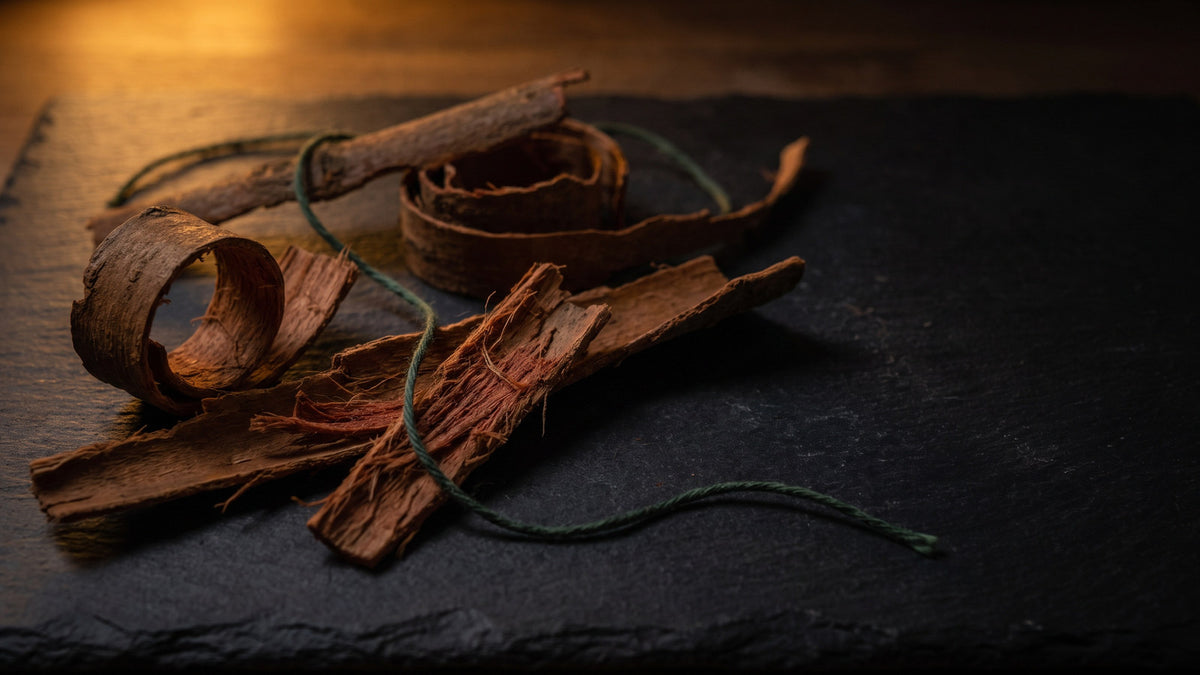
Catuaba is a trade name, not a plant. More than twenty species are sold under it, and the three that matter are Trichilia catigua (Meliaceae, bark), Erythroxylum vacciniifolium (Erythroxylaceae, bark) and Anemopaegma arvense (Bignoniaceae, root). Only the Latin binomial on the label tells you which one you bought.
The milligram figure settles nothing on its own. 500 mg of milled bark and 500 mg of a 10:1 extract differ by a factor of ten in plant material, and catuaba has no standardisation marker in general use, so species, plant part, form and weight all have to be read together.
Catuaba is the quietest name on our label and the hardest one to pin down. It is 10 mg of bark in a 100 mg tablet. It is also a word that at least two unrelated Brazilian trees answer to - different families, different corners of the country, sold under the same name in the same shops.
That is not a technicality. It means a pack that says 'catuaba bark' has told you very little about what is inside it. Here is how to work out which tree you are holding, what the number on the front is actually measuring, and where the tradition ends.
Which plant is actually sold as catuaba?
A 2017 review of the plant in the Revista Brasileira de Farmacognosia opens with the problem rather than burying it: more than twenty species are known as catuaba, and the one most commonly found in Brazil under that name is Trichilia catigua A. Juss. Three of those species account for most of what is sold. They are worth taking one at a time, because they are not variations on a theme. They are separate plants.
Trichilia catigua belongs to the Meliaceae, the mahogany family, in the order Sapindales. It is a small tree or large shrub, usually three to six metres, and the bark is the part used. Brazil's national flora database records it in thirteen states and across all four of the country's major vegetation domains - Atlantic forest, cerrado, caatinga and Amazon - and its range continues into Paraguay, Argentina, Bolivia and Peru. It is not a rare plant or a localised one. It is a common small tree across a very large area, which is part of why it came to dominate the trade.
The second catuaba: a shrub from a different family
Erythroxylum vacciniifolium is a different plant in every sense that matters. It sits in the Erythroxylaceae, in the order Malpighiales - a separate branch of the flowering plants altogether, no more closely related to Trichilia than a willow is to an apple. It is a shrub rather than a tree. The Brazilian flora records it in two states only, Bahia and Minas Gerais, growing on rock in campo rupestre and semi-deciduous forest within the caatinga, the dry thorn scrub of the north-east. The bark is again the part used. Its name is also spelled vaccinifolium, with one i, in a good deal of the literature and on some labels; both spellings point to the same shrub. The genus it belongs to also contains Erythroxylum coca, which is why the family name is familiar to people who have never given catuaba a thought.
The third is not a tree at all. Anemopaegma arvense sits in the Bignoniaceae, and Brazil's flora database gives its common names as catuaba and catuaba-verdadeira - 'true catuaba'. It is a low shrub of the cerrado and the high grasslands of central Brazil, and the part traditionally used is the root rather than the bark. So a jar labelled catuaba may not contain bark at all.
Then there is the name that appears on more packs than any of these: Erythroxylum catuaba. It was described once, in 1904, and it is not known today which tree that description referred to, which is why it is generally not treated as a recognised species. The reference databases disagree about it even now. Some file it as a synonym of E. vacciniifolium; at least one still lists it as an accepted name in its own right. A binomial that taxonomists cannot agree on is not much of an identification.
Beyond those four, barks sold as catuaba have been traced to genera in five further families - Ilex (Aquifoliaceae), Micropholis (Sapotaceae), Phyllanthus (Phyllanthaceae), Secondatia (Apocynaceae) and Tetragastris (Burseraceae) - along with unnamed members of the myrtle family.
| Sold as catuaba | Family | Part used | Where it grows |
|---|---|---|---|
| Trichilia catigua | Meliaceae (mahogany family) | Bark | Thirteen Brazilian states; also Paraguay, Argentina, Bolivia, Peru |
| Erythroxylum vacciniifolium | Erythroxylaceae | Bark | Bahia and Minas Gerais only, on rock in dry caatinga country |
| Anemopaegma arvense | Bignoniaceae | Root | Cerrado and high grassland, central Brazil |
| Erythroxylum catuaba | Erythroxylaceae, as published | Bark | No verified population; identity unresolved since 1904 |
| Ilex, Micropholis, Phyllanthus, Secondatia, Tetragastris | Five further families | Bark | Brazil, various |
What testing found in 14 commercial catuaba products
The scale of the mix-up has been measured properly once. In 2004 a group led from the University of Vienna bought fourteen commercial catuaba products, labelled as Anemopaegma, Erythroxylum or Trichilia species, and tested what was actually in them. Only a minority contained the material named on the label. More than half were adulterated with a different crude drug altogether. The bark most commonly found, whatever the label said, was Trichilia catigua.
It is easy to get away with, for a reason that has nothing to do with dishonesty and everything to do with milling. Once bark has been ground to powder, the arrangement of tissue a microscopist would use to identify it has been destroyed. Nobody can look at catuaba powder and say which tree it came from. That has to be settled chemically, against a reference sample, and it has to be done by someone who decided to do it.
How do you tell which catuaba species is in the pack?
'Catuaba' on an ingredient list is a trade name. 'Catuaba (Trichilia catigua) bark, 10 mg' is an identification. The gap between those two lines is the whole subject of this article, and printing the second one costs a brand nothing.
Four things are worth looking for, in order of how much they tell you:
- the botanical species in full - genus and species, not the genus on its own;
- the plant part, because catuaba means bark for two of the species and root for a third;
- the form, meaning milled bark or an extract, and if an extract, its ratio and solvent;
- the weight of that material per tablet or capsule, rather than the weight of a 'blend'.
A label carrying all four can be checked in about ten minutes, for free. Plants of the World Online, run by Kew, the Global Biodiversity Information Facility and Brazil's own Flora e Funga do Brasil will all take a binomial and give you back the family, whether the name is accepted or a synonym, and where the plant has actually been recorded growing. If a name on a pack does not resolve to an accepted species in any of them, it is decoration.
Three traps are worth knowing before you start. The first is spelling: vacciniifolium and vaccinifolium are the same shrub, and a database search on one may miss the other. The second is synonyms: Anemopaegma mirandum, still printed on some packs, is an older name for Anemopaegma arvense, so the two are one plant. The third is names that circulate in the herbal trade without resolving to anything sensible. Juniperus brasiliensis points at a conifer genus in the Cupressaceae, which is not a Brazilian bark tree of any description. Eriotheca candolleana is a real species in the Malvaceae, the mallow family, and has nothing to do with the three plants above.
Then apply the negative test, which is quicker. A pack that says 'Catuaba Bark Powder 500 mg' and nothing else has declined to identify its own contents. It is not necessarily bad material. It is unidentified material, and after 2004 nobody selling catuaba can claim not to know why that matters. The honest version of that pack would name a species, and the reason most do not is usually that the brand buying the powder never asked its supplier either.
Our own ingredient line reads Catuaba (Trichilia catigua) bark, 10 mg. The bark comes from the Brazilian Atlantic forest, and every delivery is confirmed as that species before it goes near a tablet press, because a milled bark that has not been identity-tested is a guess.
Does 500 mg of catuaba mean more than 10 mg in a blend?
Walk the shelf and catuaba turns up in two shapes. There are single-botanical capsules, usually 500 mg and sometimes 1,000 mg, and there are small inclusions inside multi-plant tablets, ours among them at 10 mg. Fifty to one looks like a decisive gap. It is not a comparison at all until three further things are known, and on most packs none of the three is printed.
Extract ratios: why 500 mg can mean ten different things
The first is whether the material is bark or an extract of bark. Milled bark is the tree, dried and ground. An extract is bark that has been soaked in a solvent, with the liquid then drawn off and dried, so that a large weight of tree becomes a small weight of powder. The convention for describing that comes from medicines regulation: the genuine drug extract ratio, or DER, is the ratio of the quantity of plant material used to the quantity of extract that results. A 4:1 extract means four kilograms of bark yielded one kilogram of powder. A 10:1 extract means ten did. So 500 mg of milled bark and 500 mg of a 10:1 extract are not the same quantity of tree by a factor of ten, and the label prints the identical number either way.
The second is the solvent. Water, ethanol and acetone do not pull the same fraction out of a bark, so two extracts of the same species at the same ratio can be different materials. A pack that gives a ratio but not a solvent has given you half the specification.
The third is that catuaba has no standardisation marker in general use. The chemistry of Trichilia catigua bark is known in outline - it is rich in polyphenols, including the flavan-3-ols catechin, epicatechin and procyanidin B2, a group of flavalignans called the cinchonains, and phenylpropanoids such as chlorogenic acid. Research has proposed the cinchonains as species-specific markers, which is sensible, but a research proposal is not a labelling convention. There is nothing here of the sort that ginseng has, where a pack can say 'standardised to 5% ginsenosides' and that figure means the same thing on every pack that prints it. With catuaba, there is no agreed percentage of anything to declare.
So the number on the front settles very little on its own. What settles something is the full set: species, part, form, ratio and solvent if it is an extract, and weight. A 500 mg capsule that names Trichilia catigua bark powder has told you more than a 1,000 mg capsule that names nothing, and both have told you more than a 500 mg 'proprietary blend' in which catuaba is one word in a list with no weight beside it.
None of that makes 10 mg better than 500 mg, or the reverse. They are different products built on different assumptions, and comparing them on the milligram figure alone is the mistake this section is about, not an argument for our end of it. Ours is a six-plant tablet holding 100 mg of plant material in total, of which catuaba is 10 mg, taken at a maximum of one tablet in any 24-hour period. A 500 mg single-botanical capsule is a different proposition and its buyer is doing something different. The arithmetic is what we are describing. The choice is not ours to make.
What is catuaba traditionally used for, and what can you verify?
Catuaba has a long traditional reputation in Brazilian herbal practice, and the name is older than any of the botany above.† Published accounts of where the word came from differ - one traces it to Tupi roots meaning roughly 'good' and 'man', another to a term for kindness and health - and neither is settled, which is a fair description of the whole subject. What is clear is that the word arrived first and the botany was fitted to it afterwards, in the wrong order, over about a century.
How the 'true catuaba' changed species
That sequence is visible in the naming history. For much of the twentieth century Anemopaegma was the plant that Brazilian sources called the true catuaba, and it is still listed under that common name in the national flora today. The bark most often found in commercial catuaba now is Trichilia catigua. The tradition did not choose one species and keep it. It moved.
A great deal of what is written about catuaba online goes considerably further than tradition, and states what the bark does to the body. Those statements are not repeated here and none of them is being made. Catuaba holds no authorised health claim in Great Britain. Like the other five plants in our tablet, its claims sit 'on hold' under retained Regulation (EC) 1924/2006, which in practice means a food supplement label may describe what the plant is and how it has traditionally been used, marked with a dagger, and may not say what it does to you.†
Which leaves the part you can genuinely verify, and there are three pieces of it. The first is on the pack: a binomial and a plant part in the ingredient list. The second is the batch code, usually printed on the base or the side of the carton after the artwork was made, which identifies the specific run of tablets in your hand. The third is the Certificate of Analysis for that batch, issued by the laboratory that tested it, which is where the identity result for the botanical actually lives.
Those three things work together or not at all. A binomial with no batch code behind it is a printing decision. A batch code that produces no certificate is a decoration. Quote the code from your pack to hello@maleup.co.uk and the certificate for that run comes back, identity results included. Ask any brand selling catuaba for the same thing. Given what the 2004 survey found, it is a reasonable question, and the answer tells you most of what you need to know about the pack.
Catuaba is a word. Trichilia catigua is a tree. A label that prints only the first has left the most useful part out, and it is the part that can be checked.
- 'Catuaba' is a common name shared by more than twenty Brazilian species.
- Trichilia catigua (Meliaceae) is the bark most often found in commercial catuaba.
- Erythroxylum vacciniifolium is a different family; Anemopaegma arvense is a root, not a bark.
- A 2004 survey of 14 catuaba products found more than half adulterated with a different crude drug.
- Powdered bark cannot be identified under a microscope, so identity has to be tested chemically.
Common questions
What is catuaba?
Catuaba is a Brazilian trade name rather than a single plant. More than twenty species are sold under it. The bark most commonly found in commercial catuaba is Trichilia catigua, a small tree in the mahogany family. Erythroxylum vacciniifolium, an unrelated shrub, and Anemopaegma arvense, whose root is used, are also sold as catuaba.
Is catuaba safe?
Catuaba holds no authorised health claim in Great Britain and is sold here as a food supplement, not a medicine. The practical risk on a label is identity rather than the plant: a pack that names no species may contain a different bark entirely. Follow the pack's portion instructions, and speak to a pharmacist or GP if you take prescribed medicines.
What is the difference between Trichilia catigua and Erythroxylum vacciniifolium?
They are unrelated plants sold under the same name. Trichilia catigua is in the Meliaceae, the mahogany family, and is a small tree recorded across thirteen Brazilian states. Erythroxylum vacciniifolium is in the Erythroxylaceae, and is a shrub recorded only in Bahia and Minas Gerais. Both are used as bark.
Which part of the catuaba plant is used?
For Trichilia catigua and Erythroxylum vacciniifolium it is the bark. For Anemopaegma arvense, which Brazil's national flora lists under the common name catuaba-verdadeira or 'true catuaba', the part traditionally used is the root. This is why a label should state the plant part as well as the species.
Is 500 mg of catuaba better than 10 mg in a blend?
The figure alone does not answer that. Milled bark and a concentrated extract carry the same units but not the same amount of plant material: a 10:1 extract represents ten times its own weight in bark. Catuaba also has no standardisation marker in general use, so species, plant part, form and weight have to be read together.
How do I check which catuaba species I have bought?
Look for the Latin binomial and the plant part in the ingredient list, then check the name against a free database such as Plants of the World Online or Flora e Funga do Brasil. Then find the batch code on the carton and ask the brand for the Certificate of Analysis for that batch, which carries the identity result.
- Trichilia catigua: a review of its chemistry and pharmacology — Revista Brasileira de Farmacognosia
- Trichilia catigua — distribution and life form — Flora e Funga do Brasil, JBRJ
- Erythroxylum vacciniifolium — distribution and life form — Flora e Funga do Brasil, JBRJ
- Anemopaegma arvense — vernacular names — Flora e Funga do Brasil, JBRJ
- Identity and purity of commercial catuaba samples — Planta Medica 2004;70(10):993–1000 Fourteen products tested; more than half adulterated.
- Constituents of Trichilia catigua bark — PMC
- Declaration of herbal substances and preparations — drug-extract ratio — EMA
Six botanicals, 100 mg per tablet, every weight printed on the carton: Ginseng 25 mg, Maca 25 mg, Tribulus 20 mg, Guarana 10 mg, Ashwagandha 10 mg, Catuaba 10 mg. Maximum one tablet in any 24-hour period. Pressed in the UK on a GMP-registered line.
See the packs →† Describes the traditional use of these botanicals (UK 'on-hold' botanical claims under retained Regulation (EC) 1924/2006). Not authorised EFSA health claims. AllMaleUp is a food supplement, not a medicine.