

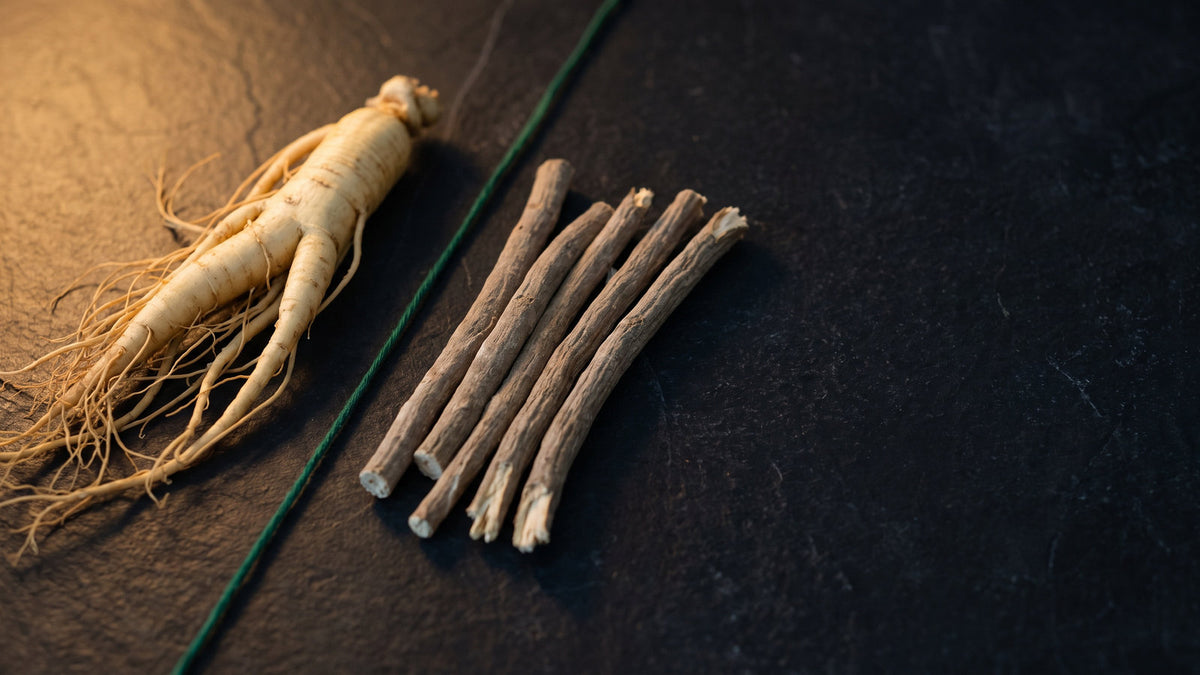
Ashwagandha and ginseng are unrelated plants. Withania somnifera, sold as 'Indian ginseng', is in the nightshade family (Solanaceae) with the potato and the tomato; Panax ginseng is in the Araliaceae, the ivy family. They share no genus, no family and not even the same order - the shared name is a trade shorthand, not a botanical fact.
Both are grown for the root, but ashwagandha is pulled six to seven months after sowing while Panax ginseng stays in the ground four to six years, which is why it costs more. Labels standardise them to different marker compounds: withanolides for ashwagandha, ginsenosides for ginseng. Neither plant holds an authorised health claim in Great Britain.
The question exists because of a name. Ashwagandha is widely sold as 'Indian ginseng', which reads like a regional variety of the ginseng in the next jar along. It is not one. The two plants sit in different botanical families and are no more closely related than a potato is to an ivy.
That is the headline answer, and it is a labelling problem before it is anything else. What follows is the botany, the two very different labels the plants carry, and how to work out from a pack which one you are holding.
Is ashwagandha a type of ginseng?
Withania somnifera is the plant sold as ashwagandha. It is a small woody shrub of hot, dry ground, and it belongs to the Solanaceae - the nightshade family, whose better-known members are the potato, the tomato, the aubergine, the chilli and tobacco. The Sanskrit name is usually translated as 'smell of the horse', a reference generally attributed to the odour of the fresh root.
Panax ginseng is the plant sold as Korean or Asian ginseng. It is a slow herbaceous perennial of shaded temperate woodland, and it belongs to the Araliaceae, the family that also contains common ivy. The genus name comes from the Greek for 'all-healing' and shares a root with the English word panacea. That is an old opinion preserved in a Latin name. It is not a finding, and nothing here reads it as one.
Family is a long way up the taxonomic ladder. Species sit inside genera, genera sit inside families, families sit inside orders. Panax ginseng and Panax quinquefolius - Asian and American ginseng - are two species in one genus, and they are genuinely close relations. Withania and Panax are not in the same genus, not in the same family, and not even in the same order. A shelf in a health-food shop is the only thing they share.
Set side by side, the two are about as different as two dried roots can be.
| Ashwagandha | Ginseng | |
|---|---|---|
| Botanical name | Withania somnifera | Panax ginseng |
| Family | Solanaceae (nightshades) | Araliaceae (ivies) |
| Also sold as | Indian ginseng, winter cherry | Korean ginseng, Asian ginseng, true ginseng |
| Part used | Root (some extracts use root and leaf) | Root |
| Planting to harvest | About six to seven months | Four to six years |
| Where ours is grown | Rajasthan, India | South Korea |
| Marker compounds on labels | Withanolides | Ginsenosides |
| Authorised GB health claim | None | None |
| Amount per AllMaleUp tablet | 10 mg | 25 mg |
Where the name 'Indian ginseng' came from
The reason the word 'ginseng' ended up attached to a nightshade is commercial rather than botanical. Both plants occupied a broadly similar position in their own traditions - a widely used root, prepared at home, taken over long stretches rather than for an occasion: Panax ginseng in Chinese and Korean practice, Withania somnifera in Ayurveda.† When Ayurvedic material began moving into English-speaking markets, 'Indian ginseng' was a shorthand that told a buyer which shelf the jar belonged on. It was never a statement about the plant's ancestry. It stuck anyway, and the search box you probably arrived through is the result.
The same instinct produced the word 'adaptogen', which is worth defining because it is the other place these two plants are filed together. The term was coined in Soviet pharmacology in the middle of the last century - the exact year is disputed in the literature, with both 1947 and 1957 cited - and was applied first to a Russian shrub, then to a widening list of botanicals. It is a category of tradition and marketing. It has no standing in GB food law: there is no legal definition of an adaptogen, no authorised claim attached to the word, and nothing a brand is permitted to say on the strength of it. When you see it on a pack, read it as a shelf label, not as information.
Which part is used, and how long does each plant take to grow?
In both cases the part used is the root, and in both cases the plant is lifted whole and the root separated from the top growth. Beyond that the two crops have almost nothing in common, and the difference between them is most of the price difference you see on the shelf.
Ashwagandha is the fast one. It is a perennial shrub, but as a crop it behaves like an annual: sown, grown through a single season and pulled at the end of it, with published harvest windows running from roughly 180 to 210 days after sowing - six to seven months. Ours comes from Rajasthan in India, harvested when the plant dies back at the close of the growing season.† The ground is back in production the following year.
Why Panax ginseng is expensive
Ginseng is the slow one. A commercial crop is cultivated in South Korea and lifted after four to six years in the ground, and every one of those years is a cost. The beds are shaded, weeded, watched for disease and carried through four to six winters before a single root is sold, on land that produces nothing else in the meantime. When the crop finally comes out, the ground is exhausted; the same field is generally not replanted with ginseng for a decade or more.
That is the entire explanation for why Panax ginseng costs what it does. It is not rarity in the wild and it is not processing. It is the calendar, plus a piece of land that can only do the job once in a generation. Ashwagandha, grown on a six-month cycle on ground that recovers immediately, sits at a different price for the same reason.
One labelling consequence follows from all this, and it catches people out. Ashwagandha material is not always root. Several widely sold extracts are made from root and leaf together, and the label should say which - 'root extract' and 'root and leaf extract' are different materials from the same plant. Ginseng has its own version of the problem: the main root, the fine lateral roots and the rhizome are not identical material either, and the compounds measured in them differ. A pack that names the plant but not the part has told you less than it appears to.
What do ginsenosides and withanolides mean on a label?
A standardisation marker is a compound, or a family of compounds, chosen to stand in for a plant material when that material is measured. It is a convention for testing, nothing more. It confirms the material was analysed and that a stated proportion of a known compound was found in it. It does not establish that the compound is why anyone takes the plant, and in Great Britain it cannot be used to say what the plant does.
For Panax ginseng the markers are the ginsenosides, a group of triterpene saponins. More than thirty have been identified, and they are most concentrated in the root. Extracts are standardised to a total ginsenoside figure; a long-established European ginseng extract, on the market since the early 1960s, is standardised to 4 per cent.
For Withania somnifera the markers are the withanolides, which are steroidal lactones - a chemically unrelated family of compounds. Commercial root extracts are commonly specified at more than 5 per cent total withanolides, with lower grades of around 2.5 per cent also traded. The two percentages measure different things and cannot be compared with each other.
What a standardisation percentage does not tell you
A percentage on a label is a smaller number than it first appears. Four things it does not tell you:
- It is a percentage of the extract, not of the tablet. Two hundred milligrams of an extract standardised to 4 per cent contains 8 mg of marker. Without the weight of extract printed alongside it, the percentage is decoration.
- It is not a percentage of the root either. Extracts carry a drug-extract ratio - for ginseng, commonly in the region of three to seven kilograms of dried root to one kilogram of extract - so '200 mg of extract' and '200 mg of root' are not the same quantity of plant.
- A total says nothing about the split. Ginsenoside profiles vary with cultivar, growing conditions, plant part and age, so two extracts both declared at 4 per cent can be composed quite differently.
- It is not a measure of effect and cannot be offered as one. Neither plant holds an authorised health claim in Great Britain.
Our own label takes the plainer route and declares whole weights rather than extract percentages: Ginseng 25 mg, Maca 25 mg, Tribulus 20 mg, Guarana 10 mg, Ashwagandha 10 mg, Catuaba 10 mg, with the Latin name against each. That is 100 mg of botanicals per tablet, and a maximum of one tablet in any 24-hour period.
What are American, Siberian and Indian ginseng?
The naming collision is not limited to ashwagandha. Four plants routinely reach British shelves under the word:
- Korean or Asian ginseng - Panax ginseng. A true ginseng, and the one in our tablet.
- American ginseng - Panax quinquefolius. Also a true ginseng: a separate species in the same genus, native to the rich woodlands of eastern North America. Wild populations are scarce enough that international trade in the root is controlled.
- Siberian ginseng - Eleutherococcus senticosus. Not a ginseng. Same family as Panax, different genus.
- Indian ginseng - Withania somnifera. Not a ginseng, and not in the family.
Siberian ginseng, which is not a Panax either
Siberian ginseng is the awkward case, because it is the nearest miss. Eleutherococcus senticosus is a thorny shrub in the Araliaceae, so it really is a relative of Panax - but a relative in the way a parsnip is a relative of a carrot, not a variety of one. It is not native to Siberia either, and the name is not used in Russian, where the plant goes by its own. It entered Western trade in the 1960s, and the ginseng association was commercially useful enough to outlive every objection to it.
The United States eventually settled that one by statute. A provision of the 2002 farm act restricted the word 'ginseng' on a food or supplement label to plants in the genus Panax, and 'Siberian ginseng' came off American labels more or less overnight. We have found no equivalent reservation of the word in Great Britain. What applies here is the general rule, carried over in retained Regulation (EU) No 1169/2011, that food information must not mislead as to the nature or identity of a food, and that the name of a food must let you tell it apart from things it could be confused with. That is a broader instrument than a list of protected words, and it depends on somebody applying it.
Which leaves the practical question: how do you tell from the pack in your hand? Five checks, in order:
- Read the Latin binomial rather than the common name. If the first word is Panax, it is a ginseng. If it is anything else, it is not, whatever the front of the pack says.
- Check the part used - root, root and leaf, or aerial parts. Different parts are different materials.
- Check whether you are buying milled plant material or an extract. If it is an extract, look for the ratio and the marker percentage as well as the weight of extract.
- Check the country of origin, which is one of the few statements on a label that can be verified.
- Check that there is a milligram figure against each plant, rather than a single 'proprietary blend' total covering all of them.
What this article has deliberately not done is tell you which of the two to take, or what either of them is for. That is not coyness. Neither Withania somnifera nor Panax ginseng holds an authorised health claim in Great Britain; both sit among the botanicals whose claims remain 'on hold' under retained Regulation (EC) 1924/2006 while the assessment process stays unfinished. Anyone telling you what either plant does to your body is not better informed than us. They are breaking a rule.
There is also a plainer reason. A comparison of effects would need the effects of both plants to be settled, and then compared with each other under conditions that make the comparison mean something. That work has not been done in any form we could summarise honestly, and inventing a verdict to fill the gap would be worse than leaving it open. So the honest answer to 'ashwagandha or ginseng' is that this is not a question we can answer for you, and nor can a pack.
Two roots, two families, two markers, two clocks, one borrowed name. We have compared the plants and the labels because those are things that can be checked, and left the effects alone because they are not. The naming, at least, can be sorted out: one of these is a ginseng, the other is a nightshade that got given the wrong business card.
- Withania somnifera is a nightshade (Solanaceae); Panax ginseng is in the ivy family (Araliaceae).
- 'Indian ginseng' is a trade name, not a botanical one - the two plants are not related.
- Both are root crops: ashwagandha in six to seven months, ginseng in four to six years.
- Different markers on the label: withanolides for ashwagandha, ginsenosides for ginseng.
- Read the Latin binomial - if the first word is not Panax, it is not a ginseng.
Common questions
Is ashwagandha the same as ginseng?
No, and the two are not related. Ashwagandha is Withania somnifera, a member of the nightshade family alongside the potato and the tomato. Ginseng is Panax ginseng, in the Araliaceae, the family that includes ivy. They are not in the same genus, the same family or the same order. Only the marketing name overlaps.
Why is ashwagandha called Indian ginseng?
It is a trade shorthand rather than a botanical description. Both roots held a broadly similar place in their own traditions of use, so when Ayurvedic material moved into English-speaking markets 'Indian ginseng' told a buyer roughly which shelf the jar belonged on. It says nothing about the plant's ancestry, and it is the reason this question gets asked at all.
Is Siberian ginseng a real ginseng?
No. Siberian ginseng is Eleutherococcus senticosus, a thorny shrub in the same family as Panax but a different genus - a relative rather than a variety. It is not native to Siberia and the name is not used in Russian. The United States restricted the word 'ginseng' on labels to the genus Panax in 2002 for precisely this reason.
Why is Panax ginseng expensive?
The calendar. A commercial crop stays in the ground four to six years before it is lifted, on shaded beds that are weeded and watched through every one of those winters and that produce nothing else meanwhile. When the roots come out the ground is exhausted and is generally not replanted with ginseng for a decade or more.
What does '5% withanolides' or '4% ginsenosides' mean on a label?
It is the proportion of a marker compound found in the extract - not in the tablet, and not in the root. Two hundred milligrams of a 4 per cent extract holds 8 mg of marker, so the percentage means nothing without the weight beside it. A total also hides the split between individual compounds, and it is not a measure of effect.
Should I take ashwagandha or ginseng?
That question is not answered here, deliberately. Neither plant holds an authorised health claim in Great Britain - both sit among the botanicals whose claims remain 'on hold' - so nothing may be said about what either does. A comparison would also need settled effects for both plants to compare, and no such comparison exists to summarise honestly.
- Withania somnifera: a review — PMC
- Ashwagandha root: harvest and withanolide content — PMC
- Panax quinquefolius — Britannica
- American ginseng and CITES export permits — US Fish and Wildlife Service
- Eleutherococcus senticosus: a review — Molecules (MDPI)
- Regulation (EU) 1169/2011 on food information to consumers — legislation.gov.uk
Six botanicals, 100 mg per tablet, every weight printed on the carton: Ginseng 25 mg, Maca 25 mg, Tribulus 20 mg, Guarana 10 mg, Ashwagandha 10 mg, Catuaba 10 mg. Maximum one tablet in any 24-hour period. Pressed in the UK on a GMP-registered line.
See the packs →† Describes the traditional use of these botanicals (UK 'on-hold' botanical claims under retained Regulation (EC) 1924/2006). Not authorised EFSA health claims. AllMaleUp is a food supplement, not a medicine.