

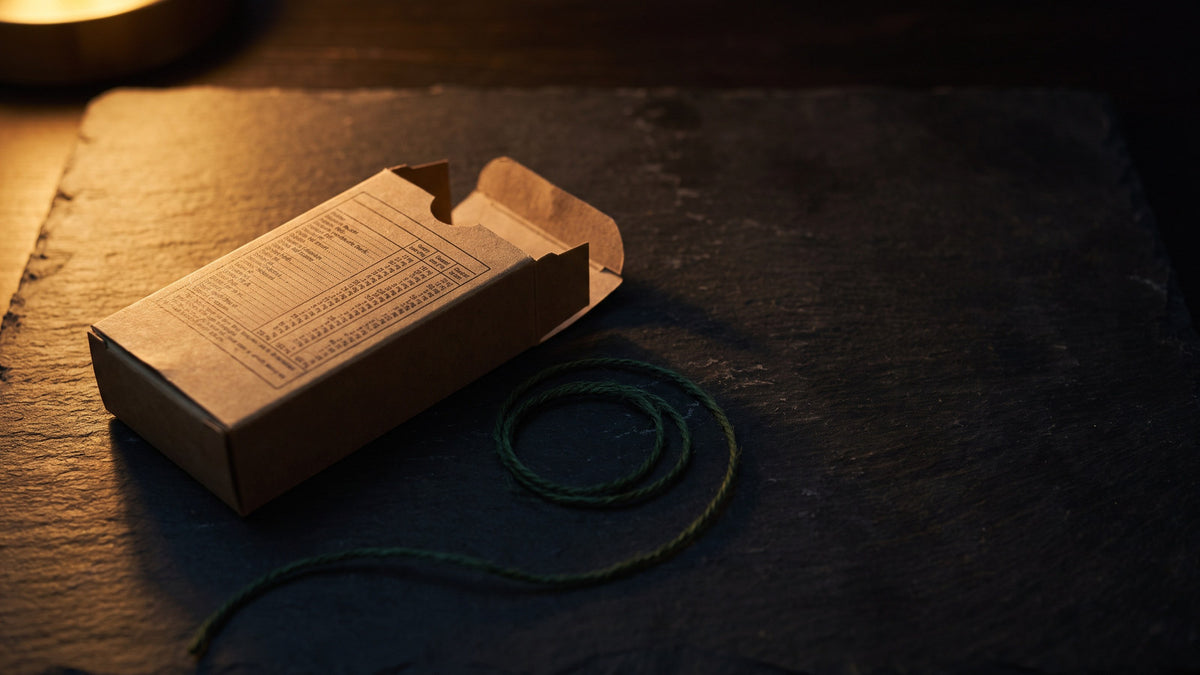
One AllMaleUp Botanical Blend tablet contains 100 mg of botanical material split six ways - Ginseng 25 mg, Maca 25 mg, Tribulus 20 mg, Guarana 10 mg, Ashwagandha 10 mg, Catuaba 10 mg - with a maximum of one tablet in any 24-hour period and under 5 mg of caffeine, all of it from the guarana.
None of the six botanicals holds an authorised health claim in Great Britain, so AllMaleUp makes no claim about what the tablet does. What is published instead is the full composition, the origin of each plant, the caffeine arithmetic, and a Certificate of Analysis for the batch code printed on your carton.
Search our name and most of what comes back was written by somebody who has never held the pack. Some of it is close. A good deal of it is guesswork about a blend whose numbers are printed on the side of the carton, where anybody could have read them.
So here is the label, read out in full, by us. What is in the tablet and how much of each. Where the six plants come from. How the pack is made and who tested it. And the question the whole aisle is arranged around - whether it works - which gets the shortest section and the plainest answer.
What is in an AllMaleUp tablet, and how much of each?
One tablet holds 100 mg of botanical material, divided six ways. Each of the six weights is declared on the pack, and the six add up to the total. That is the arrangement we would want to find on somebody else's carton, so it is the one we print on ours.
| Botanical | Species | mg per tablet | Origin |
|---|---|---|---|
| Ginseng | Panax ginseng | 25 mg | Cultivated, South Korea |
| Maca | Lepidium meyenii | 25 mg | Cultivated, Junin, Peru |
| Tribulus | Tribulus terrestris | 20 mg | Cultivated, Bulgaria |
| Guarana | Paullinia cupana | 10 mg | Wild-harvested, Maues, Brazil |
| Ashwagandha | Withania somnifera | 10 mg | Cultivated, Rajasthan, India |
| Catuaba | Trichilia catigua | 10 mg | Harvested, Brazilian Atlantic forest |
| Total | 100 mg |
Nothing is held back inside a blend total. There is no seventh plant tucked behind a rounding, and no line reading 'proprietary blend, 100 mg' with the split left to your imagination. The general version of this argument - how to read the back of any supplement pack - is a separate piece, and it applies to every brand in the aisle. What follows here is only our own label.
Why the species name is printed next to the milligrams
The Latin names are there for a practical reason rather than a decorative one. A binomial is the two-word scientific name of a species, and it identifies one plant and no other. 'Ginseng' does not. That single word is used for Panax ginseng, for American ginseng, for Siberian ginseng and for Indian ginseng, which are four unrelated plants sold under one name. Printing Panax ginseng next to the 25 mg tells you which of them was weighed out, and it lets you check a laboratory certificate against the carton without having to trust that two people meant the same thing by a common name.
What 100 mg does and does not tell you
One hundred milligrams is a small number, and it is worth saying plainly what that does and does not tell you. It tells you the tablet is not a large dose of anything. It also tells you that any pack promising a great deal on the strength of a figure like this is promising a great deal from very little. What it does not tell you is whether the tablet is weak or strong, because milligrams of plant material do not compare across materials the way milligrams of a vitamin do. A declared weight records how much went in. It says nothing on its own about the material it was weighed from. The number is not a verdict; it is the input to one.
What a declared weight is genuinely good for is comparison. Set our six figures beside another pack's six figures and the comparison takes a few seconds. Set them beside a single undivided blend total and it cannot be done at all, by you or by anybody else, including whoever wrote that label. That is the whole practical value of printing the numbers, and it is enough on its own to be worth doing.
How many AllMaleUp tablets can you take in a day?
The pack says a maximum of one tablet in any 24-hour period, taken with water, with or without food, at any time of day. The word carrying the weight there is maximum.
A ceiling is not a target. There is no course to complete, no loading period, no instruction anywhere on our carton to take one every day for a set number of weeks, and no circumstance in which there is a reason to take two. If you take one on a Tuesday and the next one a fortnight later, you have used the product exactly as the label describes. We have deliberately not written a routine into the pack, because a routine implies we know something about what the tablet is doing over the course of that routine, and we do not.
The tablet is for adults over 18. There is no age above that at which the instruction changes, and none below it at which the product becomes appropriate.
How much caffeine is in one tablet
Guarana is the only one of the six that arrives with caffeine attached. Guarana seed contains caffeine naturally: it is not added, and it cannot be removed without removing the plant. Our declared figure is under 5 mg of caffeine per tablet, which is less than a cup of decaffeinated coffee.
The working behind that is short enough to set out. Published analyses put the caffeine content of dried guarana seed at roughly 2% to 8% of dry weight. Ten milligrams of seed at 2% gives 0.2 mg of caffeine. The same 10 mg at 8%, the top of the published range, gives 0.8 mg. Anywhere in that band the answer is under a milligram. So the declared figure of under 5 mg is not an estimate of the average tablet. It is a ceiling, and it is set well above the arithmetic on purpose, because a declared figure has to hold for every tablet in every batch, through seasonal variation in the raw material and the tolerance of the test method itself. A ceiling drawn tight against the average is a ceiling that the first unusual harvest breaks.
Two other lines from the pack belong here. The tablets are suitable for vegetarians and are free from allergens. And the pack is not for everybody: not for under-18s, not for anyone taking prescription medicine or living with a diagnosed condition without speaking to their GP first, and not for anyone who avoids caffeine, however small the figure on the label happens to be.
Where is AllMaleUp made, and who tests it?
The origin column in the table is not there for atmosphere. Botanical raw material passes through collectors, driers, brokers and extractors before it reaches a manufacturer, and by then it can have changed hands half a dozen times. Knowing which country a plant came from, and whether it was cultivated or gathered wild, is one of the few things on a supplement label that can be checked back down that chain. Ginseng, maca, tribulus and ashwagandha are cultivated crops. Guarana is wild-harvested in the Maues region of Brazil. Catuaba is harvested in the Brazilian Atlantic forest.
Each of the six has a long record of traditional use in the region it comes from.† That is a statement about history rather than about your body, and it is the only sort of statement about these plants that a British label is permitted to carry. It is marked with a dagger for that reason, and the dagger resolves to the footnote at the end of this article.
The tablets are pressed in the United Kingdom on a line registered to Good Manufacturing Practice. GMP is the body of rules covering how a production facility is run: documented procedures, controlled materials, trained staff, and records kept for every batch that leaves the building. It is a standard for the process, not a verdict on the product, and it is worth being clear about that distinction. A GMP registration says the factory can account for what it did. It does not say the tablet does anything.
Testing is carried out at a laboratory accredited to ISO/IEC 17025, the international standard for the technical competence of testing laboratories. Accreditation means an independent assessment body has examined the laboratory's methods, equipment and people and confirmed they are fit to produce the results they issue. That is what separates a test result from a number on a letterhead, and it is the reason the accreditation is worth naming rather than simply saying the product is 'lab tested', a phrase that means nothing on its own.
How to get the certificate for your own batch
Two things are printed on the blister foil itself: a batch code and a best-before date. The date is a quality date. The code identifies the specific production run sitting in your hand, and it is what the paperwork is filed against. Send that code to hello@maleup.co.uk and we will send back the Certificate of Analysis for that batch - not a specimen certificate, not last year's run, but the one covering the tablets you bought. That is the only address involved and that is the whole of the process. The tablets themselves are blister-packed, one to a pocket, so each is sealed until the moment it is pushed out.
Does AllMaleUp work?
This is the direct answer to the question most people arrive with, and it is better given early than buried at the bottom. We cannot tell you that AllMaleUp works, because we are not able to tell you what it would be working on.
In Great Britain, what a food business may say about a food is governed by retained Regulation (EC) 1924/2006. Any statement that a food or one of its ingredients does something to a function of the body is a health claim, and a health claim has to sit on the authorised register before anybody is allowed to use it. Not one of the six plants in this tablet appears on that register. Their claims are 'on hold' - a holding position created while the botanical assessments were finished off, except that the assessments were never finished off. They have been in that state for well over a decade, and there is no sign of it resolving.
So we make no claim of any kind about what the tablet does. Not to any organ, function, condition, feeling or state, and not to whatever it was you typed into the search box before you arrived at this page. We are not denying particular effects one at a time, which would be its own sort of hinting. We are declining the entire category, because the entire category is closed to us. A brand selling the same six plants that tells you what theirs does is not better informed than we are. It is breaking a rule that applies to every one of us equally, and the rule is not obscure.
What we offer instead is arithmetic, all of it printed on the pack and none of it requiring you to take our word for anything:
- six declared weights, adding to 100 mg, with nothing pooled into a blend total;
- six Latin binomials, so the species is not in question;
- six origins, and whether each was cultivated or gathered wild;
- a caffeine figure of under 5 mg, with the working shown above;
- a ceiling of one tablet in any 24-hour period;
- a batch code, and a certificate for that batch on request.
There is one more number, and it is arithmetic too. Twenty tablets are £14.95, forty are £24.95 and sixty are £34.95, which works out at 75p, 62p and 58p a tablet. We would rather you did that division yourself than accepted a phrase like 'great value' from the people selling it.
Whether any of that adds up to something worth buying is a judgement we cannot make for you and are not permitted to help you with. A sceptical reader is the right sort of reader for this shelf, and a sceptical reader is not moved by adjectives. The only thing we have that survives scepticism is the set of figures above, and the fact that each of them is checkable against a certificate we will send you on request.
The most persuasive thing about this pack is dull: every number on it is printed, and every one of them can be checked. Six weights, six species, six origins, one caffeine ceiling, one dosing ceiling, one batch code and one email address. The conclusions are left to you, which is where the law puts them and, on the whole, where they belong.
- 100 mg per tablet, split six ways, every milligram declared on the pack.
- A Latin binomial identifies the species; the common name does not.
- Under 5 mg of caffeine per tablet, all of it from the 10 mg of guarana.
- One tablet in any 24-hour period is a ceiling, not a daily routine.
- No authorised GB health claim exists for any of the six, so none is made.
Common questions
Does AllMaleUp work?
We are not able to tell you that, and nor is anybody else selling these six plants in Great Britain. None of them holds an authorised health claim, so no statement about what the tablet does may be made. What we publish instead is the full composition in milligrams, the origin of each plant, the caffeine figure and a certificate for your own batch.
What is in AllMaleUp Botanical Blend?
One tablet contains 100 mg of botanical material in six declared amounts: Ginseng (Panax ginseng) 25 mg, Maca (Lepidium meyenii) 25 mg, Tribulus terrestris 20 mg, Guarana (Paullinia cupana) 10 mg, Ashwagandha (Withania somnifera) 10 mg and Catuaba (Trichilia catigua) 10 mg. Nothing is pooled into an undeclared proprietary blend total.
How much caffeine is in an AllMaleUp tablet?
Under 5 mg per tablet, and all of it comes from the 10 mg of guarana seed rather than being added. Published analyses put dried guarana seed at roughly 2% to 8% caffeine by dry weight, so 10 mg works out under a milligram. The declared figure is a ceiling set well above that, and it is less than a cup of decaffeinated coffee.
How many AllMaleUp tablets can you take a day?
A maximum of one tablet in any 24-hour period, taken with water, with or without food, at any time of day. That figure is a ceiling rather than a schedule. The pack sets out no course to complete and no daily routine to follow, and there is no circumstance in which two tablets are appropriate. It is for adults over 18.
Does AllMaleUp have side effects?
We are not permitted to describe what the tablet does in the body, in either direction. It is a food supplement, not a medicine. What the pack does state is a ceiling of one tablet in 24 hours, under 5 mg of caffeine, and who it is not for: under-18s, anyone on prescription medicine or with a diagnosed condition who has not spoken to their GP, and anyone avoiding caffeine.
Where is AllMaleUp made, and how do I get a Certificate of Analysis?
The tablets are pressed in the United Kingdom on a line registered to Good Manufacturing Practice, and testing is carried out at a laboratory accredited to ISO/IEC 17025. A batch code and best-before date are printed on the blister foil. Email that code to hello@maleup.co.uk and we send the certificate for that production run.
- Food Supplements (England) Regulations 2003, regulation 6 — labelling particulars — legislation.gov.uk
- Regulation (EC) 1924/2006 on nutrition and health claims — legislation.gov.uk
- Great Britain nutrition and health claims (NHC) register — GOV.UK None of the six botanicals in this tablet appears on it.
- ISO/IEC 17025:2017 — competence of testing laboratories — ISO
Six botanicals, 100 mg per tablet, every weight printed on the carton: Ginseng 25 mg, Maca 25 mg, Tribulus 20 mg, Guarana 10 mg, Ashwagandha 10 mg, Catuaba 10 mg. Maximum one tablet in any 24-hour period. Pressed in the UK on a GMP-registered line.
See the packs →† Describes the traditional use of these botanicals (UK 'on-hold' botanical claims under retained Regulation (EC) 1924/2006). Not authorised EFSA health claims. AllMaleUp is a food supplement, not a medicine.